Ch. 13 - Alcohols, Ethers and Related Compounds: Substitution and Elimination
Mullins - Organic Chemistry: A Learner Centered Approach 1st Edition
Mullins1st EditionOrganic Chemistry: A Learner Centered ApproachISBN: 9780137566471Not the one you use?Change textbook
Chapter 12, Problem 94a

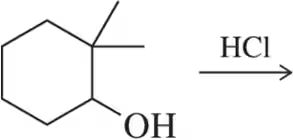
Predict the product of the following reactions.
(a) Cyclohexanol reacts with HCl, arrow indicates conversion to a new product.

Verified step by step guidance
1
Identify the type of reaction taking place. Common types include substitution, elimination, addition, and rearrangement reactions. Determine which category the given reaction falls into based on the reactants and conditions provided.
Analyze the structure of the reactants. Look for functional groups, stereochemistry, and any other relevant structural features that might influence the reaction pathway.
Consider the reaction conditions, such as temperature, solvent, and catalysts, as these can significantly affect the reaction mechanism and the final product.
Apply the appropriate reaction mechanism to predict the product. For example, if it's a nucleophilic substitution reaction, identify the nucleophile and electrophile, and determine how they will interact to form the product.
Verify the stability of the predicted product. Consider factors such as resonance, steric hindrance, and electronic effects to ensure that the product is the most stable and likely outcome of the reaction.

Verified video answer for a similar problem:

This video solution was recommended by our tutors as helpful for the problem above.
Video duration:
3m
Was this helpful?

Key Concepts

Here are the essential concepts you must grasp in order to answer the question correctly.

Reaction Mechanism

A reaction mechanism describes the step-by-step sequence of elementary reactions by which overall chemical change occurs. Understanding the mechanism is crucial for predicting the products, as it involves identifying intermediates, transition states, and the movement of electrons. This knowledge helps in determining the final structure of the product.
Recommended video:
Guided course
02:16
Heck Reaction Mechanism

Functional Groups

Functional groups are specific groups of atoms within molecules that have characteristic properties and reactivity. Recognizing these groups in the reactants is essential for predicting the outcome of a reaction, as they often dictate the type of reaction that will occur, such as addition, substitution, or elimination.
Recommended video:
Guided course
02:36
Identifying Functional Groups

Regioselectivity and Stereoselectivity

Regioselectivity refers to the preference of one direction of chemical bond making or breaking over all other possible directions. Stereoselectivity involves the formation of one stereoisomer over another in a chemical reaction. Both concepts are vital for predicting the major product of a reaction, especially when multiple products are possible.
Recommended video:
Guided course
05:09
Heck Reaction