Ch. 13 - Alcohols, Ethers and Related Compounds: Substitution and Elimination
Mullins - Organic Chemistry: A Learner Centered Approach 1st Edition
Mullins1st EditionOrganic Chemistry: A Learner Centered ApproachISBN: 9780137566471Not the one you use?Change textbook
Chapter 12, Problem 39

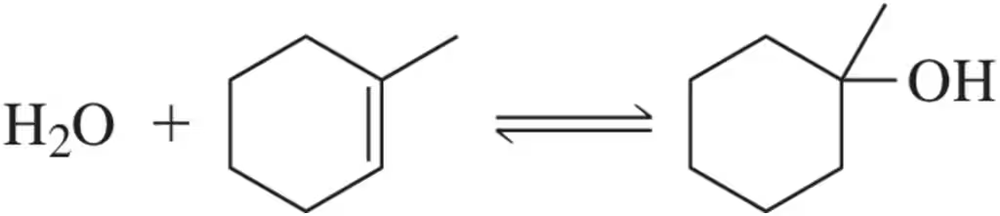
Predict which side of the equilibrium is favored by ∆H, ∆G, and ∆S.
Chemical reaction diagram showing water and a hexagonal structure converting to a hexagonal structure with an OH group.

Verified step by step guidance
1
Step 1: Analyze the reaction provided. The reaction involves the addition of water (H₂O) to a cyclohexene molecule, resulting in the formation of cyclohexanol. This is a hydration reaction.
Step 2: Consider the enthalpy change (∆H). Hydration reactions typically release energy because bonds are formed in the product (cyclohexanol) that are stronger than the bonds broken in the reactants. Therefore, ∆H is likely negative, favoring the product side.
Step 3: Evaluate the entropy change (∆S). The reaction involves combining two molecules (H₂O and cyclohexene) into one molecule (cyclohexanol). This results in a decrease in the number of particles, leading to a decrease in entropy (∆S is negative). A negative ∆S favors the reactant side.
Step 4: Assess the Gibbs free energy change (∆G). The relationship between ∆G, ∆H, and ∆S is given by the equation: ΔG=ΔH-TΔS. At lower temperatures, the negative ∆H may dominate, favoring the product side. At higher temperatures, the negative ∆S may dominate, favoring the reactant side.
Step 5: Predict the equilibrium position. If ∆G is negative, the equilibrium will favor the product side (cyclohexanol). If ∆G is positive, the equilibrium will favor the reactant side (cyclohexene and H₂O). The temperature plays a crucial role in determining which side is favored.

Verified video answer for a similar problem:

This video solution was recommended by our tutors as helpful for the problem above.
Video duration:
6m
Was this helpful?

Key Concepts

Here are the essential concepts you must grasp in order to answer the question correctly.

Le Chatelier's Principle

Le Chatelier's Principle states that if a dynamic equilibrium is disturbed by changing the conditions, the position of equilibrium shifts to counteract the change. In the context of the given reaction, adding or removing reactants or products will influence which side of the equilibrium is favored, helping to predict the direction of the reaction.
Recommended video:
Guided course
04:12
The Electron Configuration

Gibbs Free Energy (∆G)

Gibbs Free Energy (∆G) is a thermodynamic potential that measures the maximum reversible work obtainable from a thermodynamic system at constant temperature and pressure. A negative ∆G indicates that a reaction is spontaneous and favors the products, while a positive ∆G suggests that the reactants are favored. Understanding ∆G is crucial for predicting the favorability of the equilibrium position.
Recommended video:
Guided course
05:02
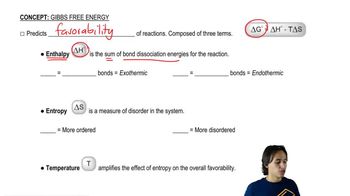
Breaking down the different terms of the Gibbs Free Energy equation.

Enthalpy (∆H) and Entropy (∆S)

Enthalpy (∆H) refers to the heat content of a system, while Entropy (∆S) measures the disorder or randomness of a system. The relationship between these two concepts, along with temperature, is described by the Gibbs Free Energy equation (∆G = ∆H - T∆S). Analyzing ∆H and ∆S helps determine the thermodynamic favorability of a reaction and the direction in which the equilibrium will shift.
Recommended video:
Guided course
02:46
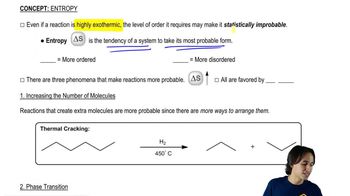
Explaining what entropy is.