Ch. 13 - Alcohols, Ethers and Related Compounds: Substitution and Elimination
Mullins - Organic Chemistry: A Learner Centered Approach 1st Edition
Mullins1st EditionOrganic Chemistry: A Learner Centered ApproachISBN: 9780137566471Not the one you use?Change textbook
Chapter 12, Problem 38

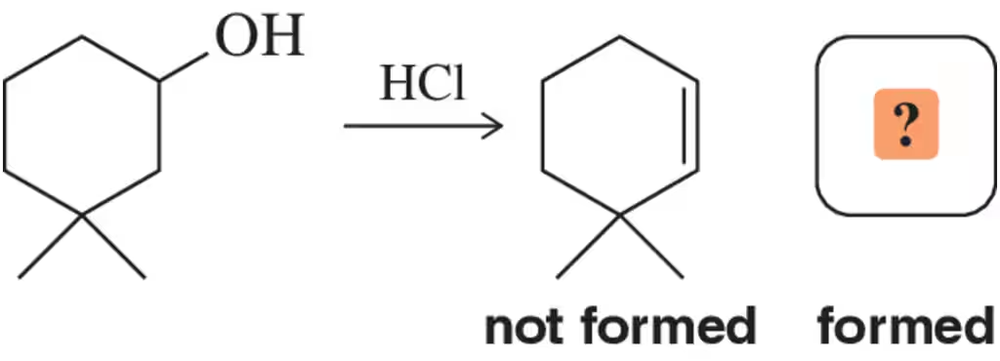
When HCl was used for the attempted dehydration reaction shown, a reaction occurred, but none of the desired product was formed. Suggest the identity of the actual product obtained.
Chemical reaction diagram showing dehydration with HCl; product not formed indicated with a question mark.

Verified step by step guidance
1
Step 1: Begin by analyzing the dehydration reaction. Dehydration reactions typically involve the removal of a water molecule from an alcohol to form an alkene. In this case, HCl is used as the acid catalyst, which can protonate the alcohol group.
Step 2: Consider the mechanism of the reaction. When HCl is added, the hydroxyl group (-OH) of the alcohol is protonated to form a good leaving group, water (H₂O). This step is crucial for the formation of a carbocation intermediate.
Step 3: Evaluate the stability of the carbocation intermediate formed after the departure of water. Carbocation stability is influenced by factors such as hyperconjugation and resonance. If the carbocation can rearrange to a more stable form, it will do so.
Step 4: Recognize that HCl introduces chloride ions (Cl⁻) into the reaction mixture. These chloride ions can act as nucleophiles and attack the carbocation, leading to the formation of a substitution product (an alkyl chloride) instead of the desired alkene.
Step 5: Conclude that the actual product obtained is likely an alkyl chloride, formed via nucleophilic attack by Cl⁻ on the carbocation intermediate. This substitution reaction competes with the intended elimination reaction, preventing the formation of the desired alkene.

Verified video answer for a similar problem:

This video solution was recommended by our tutors as helpful for the problem above.
Video duration:
1m
Was this helpful?

Key Concepts

Here are the essential concepts you must grasp in order to answer the question correctly.

Dehydration Reactions

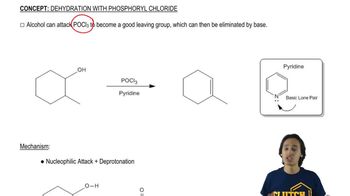
Dehydration reactions involve the removal of a water molecule from a compound, typically resulting in the formation of a double bond or a cyclic structure. In organic chemistry, these reactions are crucial for synthesizing alkenes from alcohols. Understanding the mechanism and conditions under which dehydration occurs is essential for predicting the products formed.
Recommended video:
Guided course
01:23
General Reaction of Dehydration with POCl3

Acid-Catalyzed Reactions

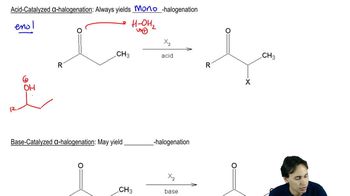
Acid-catalyzed reactions utilize acids, such as HCl, to facilitate the transformation of reactants into products. In dehydration reactions, the acid protonates the alcohol, making it a better leaving group. This concept is vital for understanding how the presence of an acid can influence the reaction pathway and the products formed, including potential side reactions.
Recommended video:
Guided course
03:09
Acid Catalyzed

Carbocation Stability

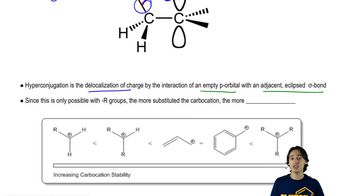
Carbocation stability is a key factor in determining the outcome of many organic reactions, including dehydration. Carbocations are positively charged carbon species that can rearrange or react further based on their stability, which is influenced by factors such as alkyl substitution and resonance. Recognizing the stability of potential carbocations helps predict the actual products formed in reactions, especially when the desired product is not obtained.
Recommended video:
Guided course
05:58
Determining Carbocation Stability