Suggest a mechanism for the reaction shown in Figure 16.30 using IZnCH₂I as the cyclopropanating reagent.
Ch. 16 - Metals in Organic Chemistry

Mullins1st EditionOrganic Chemistry: A Learner Centered ApproachISBN: 9780137566471Not the one you use?Change textbook
Chapter 15, Problem 23a
Predict the product of the following Negishi coupling reactions.
(a) 
Verified step by step guidance1
Identify the reactants involved in the Negishi coupling reaction. In this case, we have a bromobenzene derivative and an organozinc compound.
Understand the role of the catalyst and solvent. The reaction uses a palladium catalyst, Pd(PPh3)4, and is carried out in tetrahydrofuran (THF) at 0°C.
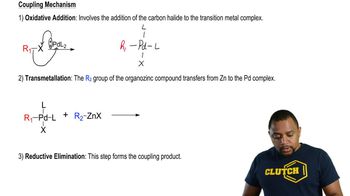
Recognize the mechanism of the Negishi coupling reaction. The palladium catalyst facilitates the formation of a carbon-carbon bond between the aryl halide and the organozinc reagent.
Predict the product by replacing the bromine atom on the aromatic ring with the alkyl group from the organozinc compound. This results in the formation of a new C-C bond.
Draw the structure of the product, which is a combination of the aromatic ring with the methoxy group and the alkyl chain from the organozinc reagent, now attached to the position where the bromine was originally located.

Verified video answer for a similar problem:
This video solution was recommended by our tutors as helpful for the problem above.
Video duration:
2mWas this helpful?
Key Concepts
Here are the essential concepts you must grasp in order to answer the question correctly.
Negishi Coupling Reaction
Negishi coupling is a cross-coupling reaction that forms carbon-carbon bonds between an organozinc compound and an organic halide, facilitated by a palladium catalyst. This reaction is highly useful in organic synthesis for constructing complex molecules. The presence of a palladium catalyst and a suitable solvent, such as THF, is crucial for the reaction's success.
Recommended video:
Guided course
Negishi Coupling Reaction
Role of Palladium Catalyst
Palladium catalysts, such as Pd(PPh3)4, are essential in facilitating the Negishi coupling reaction. They enable the oxidative addition of the organic halide to the palladium, followed by the transmetalation with the organozinc reagent, and finally, reductive elimination to form the desired carbon-carbon bond. The catalyst's efficiency is influenced by its ligands and the reaction conditions.
Recommended video:
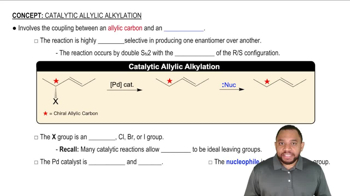
Catalytic Allylic Alkylation Concept 1
Transmetalation Process
Transmetalation is a key step in the Negishi coupling where the organozinc reagent transfers its organic group to the palladium complex. This step is crucial for forming the new carbon-carbon bond. The organozinc compound's reactivity and the reaction conditions, such as temperature and solvent, play significant roles in the efficiency of this process.
Recommended video:
Guided course
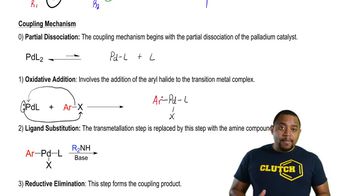
Buchwald-Hartwig Amination Reaction
Related Practice
Textbook Question
1122
views
Textbook Question
Work backward to an appropriate organozinc halide and organohalide to make the bonds indicated by the blue arrows. There may be two possibilities for each.
(b)
547
views
Textbook Question
Predict the product of the following Negishi coupling reactions.
(b)
941
views
Textbook Question
Predict the product of the following reactions.
(b)
1161
views
Textbook Question
Work backward to an appropriate organozinc halide and organohalide to make the bonds indicated by the blue arrows. There may be two possibilities for each.
(a)
855
views
Textbook Question
To determine the stereochemistry of curacin A by synthesis, it would have been necessary to prepare all stereoisomers of the C₁₇―C₂₀ cyclopropane fragment. How would the reaction in Figure 16.30 be modified to produce the other stereoisomers shown here?
856
views