Ch. 16 - Metals in Organic Chemistry
Mullins - Organic Chemistry: A Learner Centered Approach 1st Edition
Mullins1st EditionOrganic Chemistry: A Learner Centered ApproachISBN: 9780137566471Not the one you use?Change textbook
Chapter 15, Problem 21

Suggest a mechanism for the reaction shown in Figure 16.30 using IZnCH₂I as the cyclopropanating reagent.

Verified step by step guidance
1
Identify the starting materials and the reagent: The reaction involves a substrate with a double bond and the reagent IZnCH₂I, which is a cyclopropanating agent.
Understand the role of IZnCH₂I: This reagent is used to form cyclopropane rings by inserting a CH₂ group across a double bond. The zinc (Zn) acts as a stabilizing metal center that facilitates the transfer of the CH₂ group.
Initiate the mechanism by forming a carbenoid: The IZnCH₂I reagent can be thought of as generating a carbenoid species, which is a reactive intermediate similar to a carbene but stabilized by the metal (Zn).
Propose the interaction with the double bond: The carbenoid species will interact with the π electrons of the double bond in the substrate. This interaction leads to the formation of a three-membered cyclopropane ring.
Conclude the mechanism: The cyclopropanation is completed when the CH₂ group is inserted across the double bond, resulting in the formation of a cyclopropane ring. The zinc iodide (ZnI₂) is released as a byproduct.

Verified video answer for a similar problem:

This video solution was recommended by our tutors as helpful for the problem above.
Video duration:
1m
Was this helpful?

Key Concepts

Here are the essential concepts you must grasp in order to answer the question correctly.

Cyclopropanation Reaction

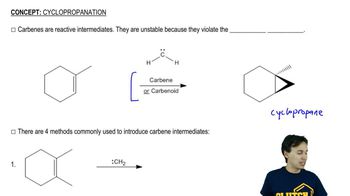
Cyclopropanation is a chemical reaction that introduces a cyclopropane ring into a molecule. It typically involves the addition of a carbene or carbenoid to an alkene, forming a three-membered ring. Understanding the nature of the cyclopropanating reagent, such as IZnCH₂I, is crucial for predicting the reaction pathway and the stereochemistry of the product.
Recommended video:
Guided course
01:49
General properties of cyclopropanation.

Carbenoid Reagents

Carbenoid reagents, like IZnCH₂I, are compounds that mimic the behavior of carbenes, which are highly reactive species with a divalent carbon atom. These reagents facilitate the formation of cyclopropane rings by transferring a CH₂ group to an alkene. Recognizing the properties and reactivity of carbenoids helps in understanding their role in cyclopropanation reactions.
Recommended video:

Reaction Mechanism

A reaction mechanism outlines the step-by-step process by which reactants transform into products, detailing the movement of electrons and the formation and breaking of bonds. For cyclopropanation using IZnCH₂I, the mechanism involves the generation of a carbenoid intermediate, its interaction with the alkene, and the subsequent formation of the cyclopropane ring. Understanding mechanisms is essential for predicting reaction outcomes and designing synthetic pathways.
Recommended video:
Guided course
02:16
Heck Reaction Mechanism