Ch. 17 - Carbonyl Addition Reactions: Aldehydes and Ketones
Mullins - Organic Chemistry: A Learner Centered Approach 1st Edition
Mullins1st EditionOrganic Chemistry: A Learner Centered ApproachISBN: 9780137566471Not the one you use?Change textbook
Chapter 16, Problem 4a

Based on the analysis you used in Assessment 17.3, which carbonyl would you expect to react most quickly with a nucleophile?
(a) Comparison of two carbonyl compounds, one with a chlorine atom and one without, illustrating nucleophilic addition reactivity.

Verified step by step guidance
1
Step 1: Analyze the two carbonyl compounds provided in the image. The first compound is an acyl chloride (RCOCl), and the second compound is a ketone (RCOR'). Acyl chlorides have a carbonyl group directly bonded to a chlorine atom, while ketones have a carbonyl group bonded to two alkyl groups.
Step 2: Consider the electronic effects of the substituents attached to the carbonyl carbon. Chlorine is highly electronegative and withdraws electron density from the carbonyl carbon through both inductive and resonance effects, making the carbonyl carbon more electrophilic. In contrast, alkyl groups in ketones are electron-donating, which reduces the electrophilicity of the carbonyl carbon.
Step 3: Recall the general reactivity of carbonyl compounds with nucleophiles. The more electrophilic the carbonyl carbon, the more reactive it is toward nucleophilic attack. Acyl chlorides are typically more reactive than ketones due to the strong electron-withdrawing effect of the chlorine atom.
Step 4: Consider steric factors. Acyl chlorides generally have less steric hindrance around the carbonyl carbon compared to ketones, which often have bulkier alkyl groups. Reduced steric hindrance facilitates nucleophilic attack.
Step 5: Conclude that the acyl chloride (RCOCl) is expected to react more quickly with a nucleophile compared to the ketone (RCOR') due to its higher electrophilicity and lower steric hindrance.

Verified video answer for a similar problem:

This video solution was recommended by our tutors as helpful for the problem above.
Was this helpful?

Key Concepts

Here are the essential concepts you must grasp in order to answer the question correctly.

Carbonyl Compounds

Carbonyl compounds contain a carbon atom double-bonded to an oxygen atom (C=O). This functional group is pivotal in organic chemistry, as it is highly reactive towards nucleophiles due to the partial positive charge on the carbon atom, making it susceptible to nucleophilic attack. The reactivity of carbonyl compounds can vary significantly based on the substituents attached to the carbonyl carbon.
Recommended video:
Guided course
01:40
Defining meso compounds.

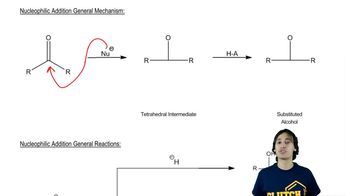
Nucleophilic Addition

Nucleophilic addition is a fundamental reaction mechanism in organic chemistry where a nucleophile attacks an electrophilic carbon atom, leading to the formation of a new bond. In the context of carbonyl compounds, the nucleophile adds to the carbonyl carbon, resulting in the conversion of the carbonyl group into an alcohol or other functional groups. The rate of this reaction is influenced by the electrophilicity of the carbonyl carbon, which can be affected by nearby electronegative atoms.
Recommended video:
Guided course
08:27
Nucleophilic Addition

Electrophilicity and Substituent Effects

Electrophilicity refers to the tendency of a molecule to attract electrons, which is crucial in determining how quickly a nucleophile will react with a carbonyl compound. The presence of electronegative substituents, such as chlorine, can enhance the electrophilicity of the carbonyl carbon by stabilizing the positive charge that develops during nucleophilic attack. Therefore, carbonyl compounds with electron-withdrawing groups tend to react more rapidly with nucleophiles compared to those without such groups.
Recommended video:
3:26
Directing Effects in Substituted Pyrroles, Furans, and Thiophenes Concept 2