Ch. 17 - Carbonyl Addition Reactions: Aldehydes and Ketones
Mullins - Organic Chemistry: A Learner Centered Approach 1st Edition
Mullins1st EditionOrganic Chemistry: A Learner Centered ApproachISBN: 9780137566471Not the one you use?Change textbook
Chapter 16, Problem 2c

Identify the following reactions as oxidation or reduction (based on what happens to the organic molecule).
(c) Reaction showing the conversion of a brominated compound to an alkene using sodium hydroxide, producing water and sodium bromide.

Verified step by step guidance
1
Step 1: Analyze the reaction. The starting material is cyclohexyl chloride (C6H11Cl), and the products are cyclohexene (C6H10), methanol (CH3OH), and sodium chloride (NaCl).
Step 2: Determine the change in the organic molecule. Cyclohexyl chloride loses a hydrogen atom and a chlorine atom, forming a double bond in cyclohexene. This indicates a change in the oxidation state of the carbon atoms.
Step 3: Recall the definition of oxidation and reduction. Oxidation involves the loss of electrons or an increase in the number of bonds to electronegative atoms (like oxygen) or the loss of hydrogen. Reduction involves the gain of electrons or an increase in the number of bonds to hydrogen.
Step 4: Evaluate the reaction. In this case, the organic molecule loses hydrogen atoms and forms a double bond, which corresponds to an increase in oxidation state. Therefore, this reaction is classified as an oxidation.
Step 5: Conclude that the reaction is an oxidation based on the changes observed in the organic molecule.

Verified video answer for a similar problem:

This video solution was recommended by our tutors as helpful for the problem above.
Video duration:
2m
Was this helpful?

Key Concepts

Here are the essential concepts you must grasp in order to answer the question correctly.

Oxidation and Reduction

Oxidation and reduction are chemical processes that involve the transfer of electrons between substances. Oxidation refers to the loss of electrons or an increase in oxidation state, while reduction involves the gain of electrons or a decrease in oxidation state. Understanding these concepts is crucial for identifying whether a reaction is an oxidation or reduction based on the changes occurring in the organic molecules.
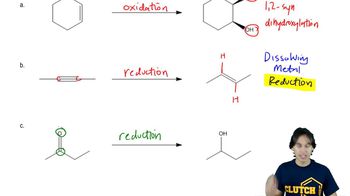
Recommended video:
Guided course
00:54
Distinguishing between Oxidation and Reduction

Nucleophilic Substitution

Nucleophilic substitution is a fundamental reaction in organic chemistry where a nucleophile attacks an electrophile, resulting in the replacement of a leaving group. In the provided reaction, methanol acts as a nucleophile, attacking the carbon atom bonded to chlorine, leading to the formation of a new bond and the release of chloride ion. Recognizing this mechanism helps in determining the nature of the reaction.
Recommended video:
Guided course
01:47
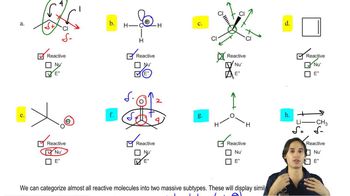
Nucleophiles and Electrophiles can react in Substitution Reactions.

Electrophiles and Nucleophiles

Electrophiles are electron-deficient species that seek electrons, while nucleophiles are electron-rich species that donate electrons. In the context of the reaction shown, the carbon atom attached to the chlorine atom acts as an electrophile, and methanol serves as a nucleophile. Understanding the roles of these species is essential for analyzing the reaction and determining whether it involves oxidation or reduction.
Recommended video:
Guided course
03:
Nucleophile or Electrophile