You might expect that aldehydes and ketones could undergo the addition/elimination mechanism. With strong nucleophiles, however, nucleophilic addition is the only outcome. Why?
Ch. 19 - Nucleophilic Acyl Substitution II: Carboxylic Acid Derivatives

Mullins1st EditionOrganic Chemistry: A Learner Centered ApproachISBN: 9780137566471Not the one you use?Change textbook
All textbooks
Mullins 1st Edition
Ch. 19 - Nucleophilic Acyl Substitution II: Carboxylic Acid Derivatives
Problem 14
Mullins 1st Edition
Ch. 19 - Nucleophilic Acyl Substitution II: Carboxylic Acid Derivatives
Problem 14Chapter 18, Problem 14
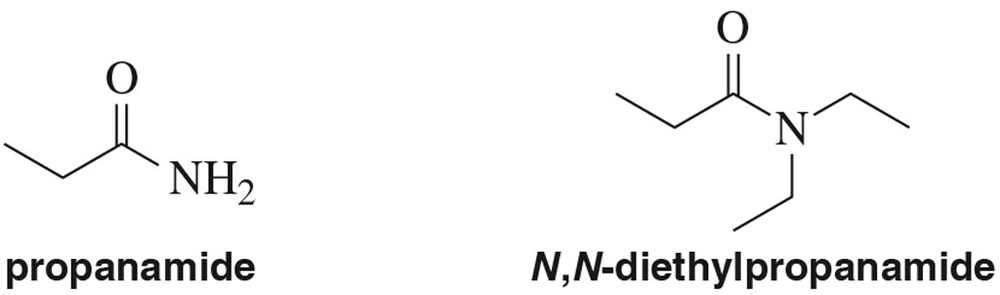
How would you expect the IR and ¹H NMR spectra for propanamide and N,N-diethylpropanamide to differ?

Verified step by step guidance1
Identify the functional groups present in propanamide and N,N-diethylpropanamide. Propanamide contains an amide group, while N,N-diethylpropanamide has an amide group with additional ethyl groups attached to the nitrogen.
For IR spectroscopy, focus on the characteristic absorption bands. Propanamide will show a strong absorption band for the C=O stretch of the amide around 1640-1690 cm⁻¹ and N-H stretches around 3200-3500 cm⁻¹. N,N-diethylpropanamide will also show the C=O stretch, but the N-H stretch will be absent due to the substitution of hydrogen atoms with ethyl groups.
In the ¹H NMR spectrum, analyze the chemical environment of hydrogen atoms. Propanamide will have signals for the amide N-H protons, typically appearing as a broad singlet. N,N-diethylpropanamide will lack these N-H signals but will show additional signals for the ethyl groups, including triplets and quartets due to the CH₂ and CH₃ groups.
Consider the splitting patterns in the ¹H NMR spectra. In propanamide, the CH₃ group will appear as a triplet due to coupling with the adjacent CH₂ group, which will appear as a quartet. In N,N-diethylpropanamide, the ethyl groups will show similar splitting patterns, but with additional complexity due to the presence of two ethyl groups.
Compare the chemical shifts in both compounds. The presence of the electron-withdrawing carbonyl group in both compounds will deshield nearby protons, but the additional ethyl groups in N,N-diethylpropanamide will cause shifts in the chemical environment, leading to different chemical shifts compared to propanamide.

Verified video answer for a similar problem:
This video solution was recommended by our tutors as helpful for the problem above.
Was this helpful?
Key Concepts
Here are the essential concepts you must grasp in order to answer the question correctly.
Infrared (IR) Spectroscopy
IR spectroscopy is a technique used to identify functional groups in organic compounds by measuring the absorption of infrared light, which causes molecular vibrations. Key absorptions for amides include the carbonyl stretch around 1650 cm⁻¹ and N-H stretches near 3300 cm⁻¹. In N,N-diethylpropanamide, the absence of N-H stretches due to substitution with ethyl groups will differentiate its IR spectrum from propanamide.
Recommended video:
Guided course
General Features of IR Spect
¹H Nuclear Magnetic Resonance (NMR) Spectroscopy
¹H NMR spectroscopy provides information about the hydrogen atoms in a molecule, including their environment and connectivity. In propanamide, the N-H protons will appear as distinct signals, while in N,N-diethylpropanamide, these signals will be absent, replaced by signals from the ethyl groups. The chemical shifts and splitting patterns will help distinguish between the two compounds.
Recommended video:
Guided course
General NMR Features
Amide Functional Group
Amides are characterized by a carbonyl group (C=O) bonded to a nitrogen atom. In propanamide, the amide group includes hydrogen atoms bonded to nitrogen, which are detectable in both IR and NMR spectra. In N,N-diethylpropanamide, the nitrogen is bonded to ethyl groups instead, altering the spectral characteristics by removing N-H signals and introducing signals from the ethyl groups.
Recommended video:
Guided course
Identifying Functional Groups
Related Practice
Textbook Question
983
views
Textbook Question
Provide a molecular structure that corresponds to the given name.
(e) (R)-N,N-diethyl 5-cyclohexyl-3-methoxypentanamide
721
views
Textbook Question
Predict the hybridization of the indicated atoms.
(b)
1341
views
Textbook Question
Provide a molecular structure that corresponds to the given name.
(a) benzoic propanoic anhydride
1057
views
Textbook Question
Predict the product of the following reductions.
(a)
955
views
Textbook Question
A chemist unsuccessfully attempted to produce the 1,4-cyclohexanediol by hydration of the cyclohexene shown.
(a) Provide a mechanism for the formation of the actual product.
(b) Suggest a pathway using acetyl chloride as a protecting group that will allow for the formation of the desired product.
1245
views