Ch. 19 - Nucleophilic Acyl Substitution II: Carboxylic Acid Derivatives
Mullins - Organic Chemistry: A Learner Centered Approach 1st Edition
Mullins1st EditionOrganic Chemistry: A Learner Centered ApproachISBN: 9780137566471Not the one you use?Change textbook
Chapter 18, Problem 11b

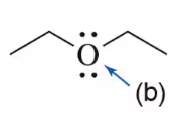
Predict the hybridization of the indicated atoms.
(b) Diagram showing an oxygen atom with electron dots and a blue arrow pointing to it, labeled (b).

Verified step by step guidance
1
Identify the atom in question and examine its bonding environment. Count the number of sigma bonds (single bonds) and lone pairs of electrons around the atom.
Use the formula for hybridization: Hybridization = (Number of sigma bonds + Number of lone pairs). This will help determine the steric number of the atom.
Match the steric number to the corresponding hybridization: steric number 2 = sp, steric number 3 = sp², steric number 4 = sp³, steric number 5 = sp³d, steric number 6 = sp³d².
Consider the geometry of the molecule to confirm the hybridization. For example, sp corresponds to linear geometry, sp² to trigonal planar, and sp³ to tetrahedral.
Verify your prediction by checking the molecular structure and ensuring that the hybridization aligns with the observed bond angles and geometry.

Verified video answer for a similar problem:

This video solution was recommended by our tutors as helpful for the problem above.
Video duration:
2m
Was this helpful?

Key Concepts

Here are the essential concepts you must grasp in order to answer the question correctly.

Hybridization

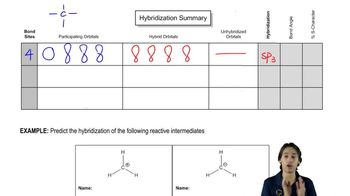
Hybridization is the concept in chemistry where atomic orbitals mix to form new hybrid orbitals, which can explain the geometry of molecular bonding. For example, in carbon, the mixing of one s and three p orbitals results in four sp3 hybrid orbitals, leading to a tetrahedral shape. Understanding hybridization helps predict molecular shapes and bond angles.
Recommended video:
Guided course
10:43
Using bond sites to predict hybridization

VSEPR Theory

Valence Shell Electron Pair Repulsion (VSEPR) Theory is used to predict the geometry of molecules based on the repulsion between electron pairs around a central atom. According to VSEPR, electron pairs will arrange themselves to minimize repulsion, leading to specific molecular shapes such as linear, trigonal planar, or tetrahedral. This theory is essential for visualizing molecular structures.
Recommended video:
Guided course
10:48
Equipment and Theory

Bonding and Lone Pairs

In molecular structures, bonding pairs of electrons are shared between atoms, while lone pairs are non-bonding electrons localized on a single atom. The presence of lone pairs can significantly affect the hybridization and geometry of a molecule, as they occupy space and influence the arrangement of bonding pairs. Recognizing the role of lone pairs is crucial for accurate predictions of molecular shape.
Recommended video:
Guided course
02:04
Heterocycles - Which lone pairs react?