Ch. 19 - Nucleophilic Acyl Substitution II: Carboxylic Acid Derivatives
Mullins - Organic Chemistry: A Learner Centered Approach 1st Edition
Mullins1st EditionOrganic Chemistry: A Learner Centered ApproachISBN: 9780137566471Not the one you use?Change textbook
Chapter 18, Problem 50

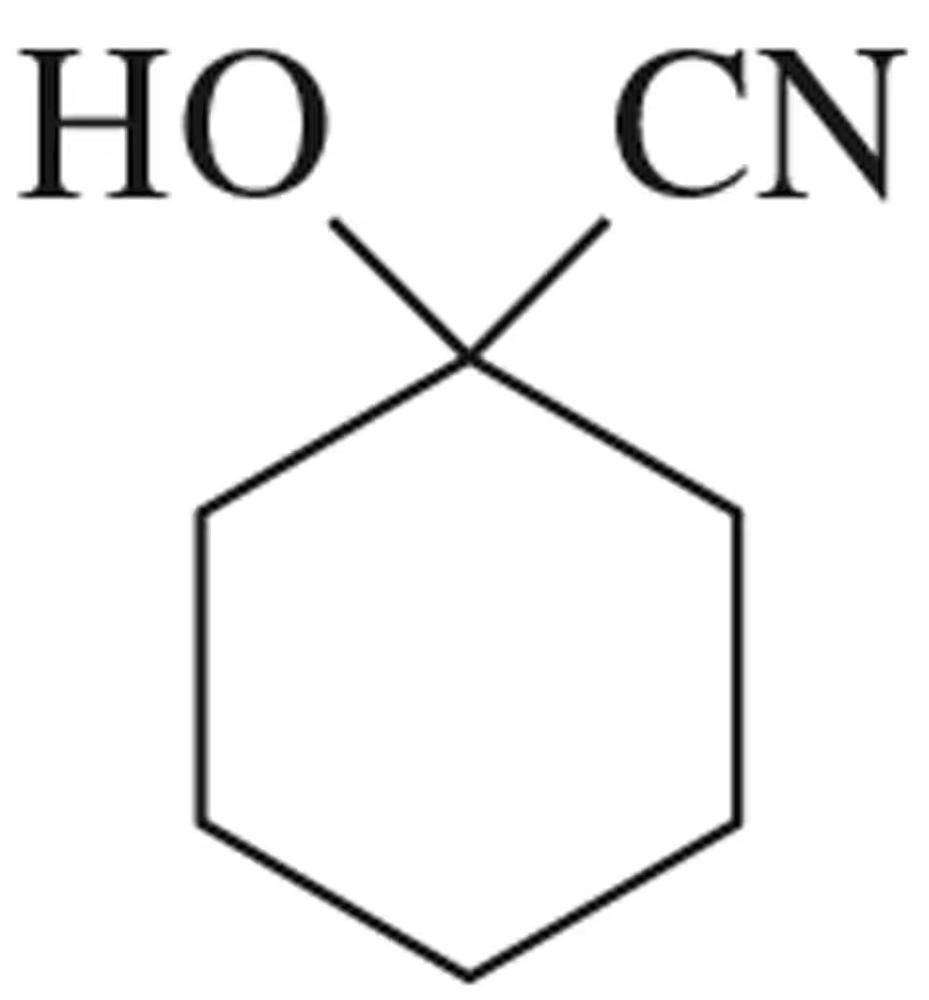
How would you synthesize the cyanohydrin shown?
Chemical structure of a cyanohydrin with hydroxyl (HO) and cyano (CN) groups attached to a hexagonal carbon ring.

Verified step by step guidance
1
Step 1: Identify the functional groups in the target molecule. The cyanohydrin contains a hydroxyl group (-OH) and a nitrile group (-CN) attached to the same carbon atom.
Step 2: Recognize the precursor for cyanohydrin synthesis. Cyanohydrins are typically synthesized from aldehydes or ketones via nucleophilic addition of hydrogen cyanide (HCN). In this case, the precursor would be cyclohexanone, a ketone.
Step 3: Prepare the reaction conditions. Cyanohydrin synthesis requires the presence of HCN, which can be generated in situ using a combination of sodium cyanide (NaCN) and a weak acid like HCl. This provides the nucleophile (CN⁻) and the proton source (H⁺) for the reaction.
Step 4: Perform the nucleophilic addition reaction. The CN⁻ ion attacks the carbonyl carbon of cyclohexanone, forming a tetrahedral intermediate. Protonation of the oxygen atom in the intermediate leads to the formation of the hydroxyl group (-OH).
Step 5: Isolate and purify the cyanohydrin product. After the reaction is complete, the cyanohydrin can be separated and purified using standard techniques such as extraction and recrystallization.

Verified video answer for a similar problem:

This video solution was recommended by our tutors as helpful for the problem above.
Was this helpful?

Key Concepts

Here are the essential concepts you must grasp in order to answer the question correctly.

Cyanohydrin Formation

Cyanohydrins are formed through the nucleophilic addition of hydrogen cyanide (HCN) to carbonyl compounds, such as aldehydes or ketones. The nucleophile, cyanide ion (CN-), attacks the electrophilic carbon of the carbonyl group, leading to the formation of a hydroxyl group and a cyano group on the same carbon atom.
Recommended video:
Guided course
02:36
Nitrile Reduction

Nucleophilic Addition Reactions

Nucleophilic addition is a fundamental reaction in organic chemistry where a nucleophile attacks an electrophile, resulting in the formation of a new bond. In the case of cyanohydrin synthesis, the nucleophile (CN-) adds to the carbonyl carbon, which is electron-deficient, facilitating the reaction and leading to the product formation.
Recommended video:
Guided course
08:27
Nucleophilic Addition

Mechanism of Reaction

Understanding the mechanism of the cyanohydrin formation involves recognizing the steps of nucleophilic attack, protonation, and stabilization of the intermediate. The reaction typically proceeds through the formation of a tetrahedral intermediate, which then collapses to yield the final cyanohydrin product, illustrating the importance of reaction mechanisms in predicting product formation.
Recommended video:
Guided course
02:16
Heck Reaction Mechanism