Beginning with an amide, two different pathways produce the same compound. Predict the product of these two pathways.
Ch. 19 - Nucleophilic Acyl Substitution II: Carboxylic Acid Derivatives

Mullins1st EditionOrganic Chemistry: A Learner Centered ApproachISBN: 9780137566471Not the one you use?Change textbook
All textbooks
Mullins 1st Edition
Ch. 19 - Nucleophilic Acyl Substitution II: Carboxylic Acid Derivatives
Problem 53b
Mullins 1st Edition
Ch. 19 - Nucleophilic Acyl Substitution II: Carboxylic Acid Derivatives
Problem 53bChapter 18, Problem 53b
Predict the product of the following reaction sequences.
(b) 
Verified step by step guidance1
Step 1: Identify the functional groups present in the starting material. This will help you understand the reactivity and possible transformations that can occur during the reaction sequence.
Step 2: Analyze the reagents and conditions provided in the reaction sequence. Each reagent can perform specific transformations, such as oxidation, reduction, substitution, or elimination. Determine the role of each reagent in the sequence.
Step 3: Apply the first reagent to the starting material. Consider the mechanism of the reaction, such as nucleophilic attack, electrophilic addition, or radical formation, and predict the intermediate product formed.
Step 4: Continue with the subsequent reagents in the sequence. For each step, predict the transformation that occurs, considering the stability and reactivity of intermediates formed. Use your knowledge of reaction mechanisms to guide your predictions.
Step 5: After applying all reagents, predict the final product. Consider stereochemistry, regiochemistry, and any rearrangements that may occur during the reaction sequence. Ensure that the final product is consistent with the transformations applied throughout the sequence.

Verified video answer for a similar problem:
This video solution was recommended by our tutors as helpful for the problem above.
Video duration:
3mWas this helpful?
Key Concepts
Here are the essential concepts you must grasp in order to answer the question correctly.
Reaction Mechanism
A reaction mechanism outlines the step-by-step process by which reactants transform into products. Understanding the mechanism is crucial for predicting the outcome of a reaction, as it involves identifying intermediates, transition states, and the movement of electrons. This concept helps in visualizing how bonds are broken and formed during the reaction.
Recommended video:
Guided course
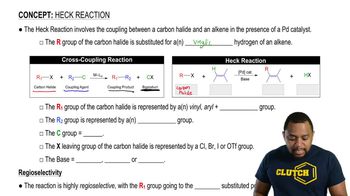
Heck Reaction Mechanism
Functional Groups
Functional groups are specific groups of atoms within molecules that are responsible for the characteristic chemical reactions of those molecules. Recognizing these groups is essential for predicting reactivity and the types of reactions that can occur. For example, knowing that an alcohol group can undergo oxidation or substitution reactions helps in anticipating possible products.
Recommended video:
Guided course
Identifying Functional Groups
Regioselectivity and Stereoselectivity
Regioselectivity refers to the preference of a chemical reaction to occur at one direction or position over others, while stereoselectivity involves the formation of one stereoisomer over another. These concepts are vital for predicting the major product of a reaction, as they determine the orientation and configuration of the product molecules, influenced by steric and electronic factors.
Recommended video:
Guided course
Heck Reaction
Related Practice
Textbook Question
1121
views
Textbook Question
Give the nitrile and organometallic reagent you would use to make the following ketones. There are two possible answers for both.
(b)
934
views
Textbook Question
How would you synthesize the cyanohydrin shown?
973
views
Textbook Question
Suggest a series of steps involving a cuprate reagent that would convert the reactant on the left to the product on the right. The ideal number of steps is shown.
(b)
862
views
Textbook Question
Give the nitrile and organometallic reagent you would use to make the following ketones. There are two possible answers for both.
(a)
981
views
Textbook Question
Suggest a series of steps involving a cuprate reagent that would convert the reactant on the left to the product on the right. The ideal number of steps is shown.
(c)
782
views