Chlorine exists as one of two isotopes with atomic masses of 34.969 amu (35Cl) and 36.966 amu (37Cl) . Calculate the relative abundance of 35Cl and 37Cl based on the average atomic mass of 35.453 amu.
Ch. 2 - General Chemistry Translated: Finding the Electrons

Mullins1st EditionOrganic Chemistry: A Learner Centered ApproachISBN: 9780137566471Not the one you use?Change textbook
All textbooks
Mullins 1st Edition
Ch. 2 - General Chemistry Translated: Finding the Electrons
Problem 10a
Mullins 1st Edition
Ch. 2 - General Chemistry Translated: Finding the Electrons
Problem 10aChapter 1, Problem 10a
A chemistry student drew the following incorrect electron configuration for carbon. (a) Correct the diagram.

Verified step by step guidance1
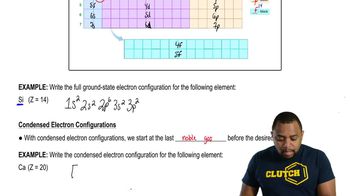
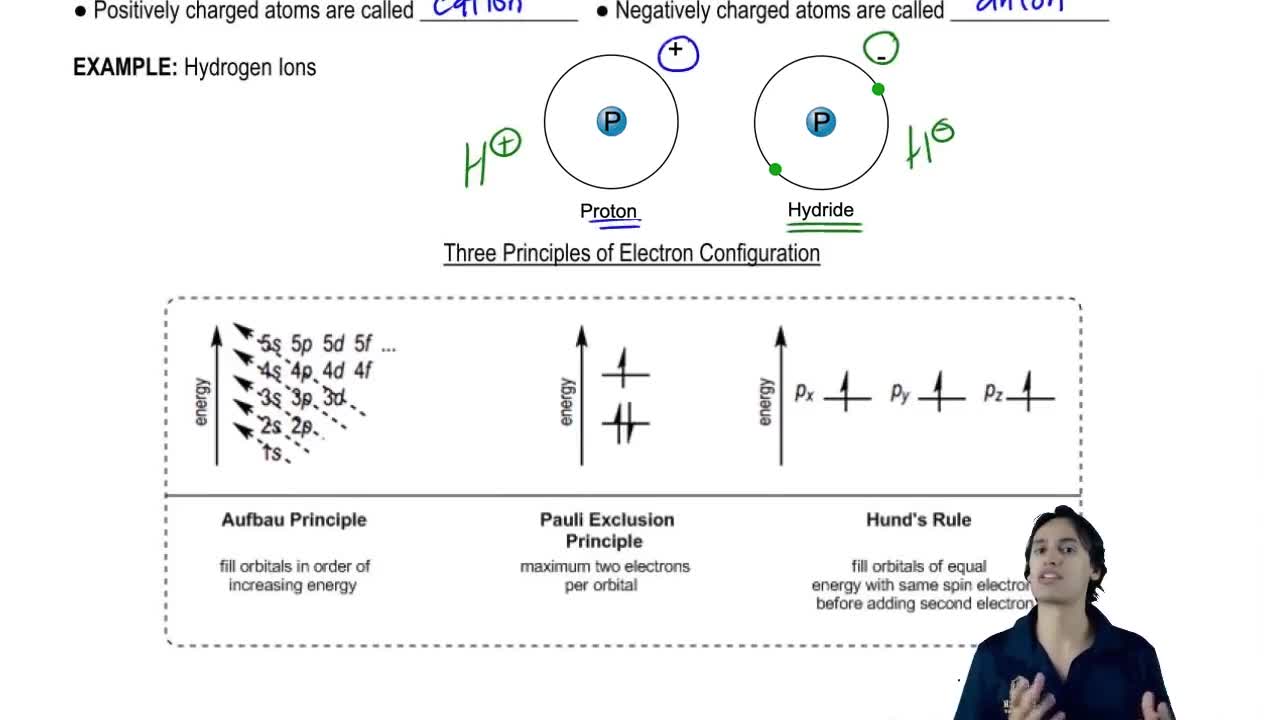
Understand the electron configuration of carbon: Carbon has an atomic number of 6, meaning it has 6 electrons. These electrons are distributed in orbitals according to the Aufbau principle, Hund's rule, and the Pauli exclusion principle.
Recall the order of orbital filling: Electrons fill orbitals in the order of increasing energy levels. For carbon, the order is 1s, 2s, and then 2p. The correct configuration should be written as: .
Apply Hund's rule for the 2p orbitals: When filling the 2p orbitals, electrons are placed in separate orbitals with parallel spins before pairing. This minimizes electron repulsion and stabilizes the atom.
Correct the diagram: Ensure that the 1s and 2s orbitals are fully filled with two electrons each, and the 2p orbitals have one electron in two separate orbitals with parallel spins.
Double-check the corrected diagram: Verify that the total number of electrons is 6, and that the configuration adheres to the principles of electron distribution (Aufbau principle, Hund's rule, and Pauli exclusion principle).

Verified video answer for a similar problem:
This video solution was recommended by our tutors as helpful for the problem above.
Video duration:
4mWas this helpful?
Key Concepts
Here are the essential concepts you must grasp in order to answer the question correctly.
Electron Configuration
Electron configuration describes the distribution of electrons in an atom's orbitals. For carbon, which has six electrons, the correct configuration is 1s² 2s² 2p². This notation indicates that two electrons occupy the 1s orbital, two occupy the 2s orbital, and two occupy the 2p orbitals, reflecting the principles of quantum mechanics.
Recommended video:
Guided course
The Electron Configuration
Aufbau Principle
The Aufbau principle states that electrons fill atomic orbitals in order of increasing energy levels, starting from the lowest. This means that before electrons can occupy higher energy orbitals, such as 2p, the lower energy orbitals (1s and 2s) must be filled first. Understanding this principle is crucial for accurately determining the electron configuration of an element.
Recommended video:
Guided course
The Electron Configuration
Pauli Exclusion Principle
The Pauli Exclusion Principle asserts that no two electrons in an atom can have the same set of four quantum numbers. This principle explains why each orbital can hold a maximum of two electrons with opposite spins. It is essential for understanding how electrons are arranged in orbitals and helps prevent incorrect configurations.
Recommended video:
Guided course
Three rules about orbitals you need to know.
Related Practice
Textbook Question
1336
views
Textbook Question
Choose the larger atom in each pair.
(b) O or F
1150
views
Textbook Question
Why is argon considered to be so stable that it is referred to as a noble gas?
1465
views
Textbook Question
Would you expect electrons in the 2s or 3s orbital to be more reactive? Why?
1251
views
Textbook Question
A chemistry student drew the following incorrect electron configuration for carbon. (b) Which rule wasn't followed by the student?
1436
views
Textbook Question
Bromine-79 (50.7% abundance) has an atomic mass of 78.918 amu, whereas bromine-81 (49.3% abundance) has an atomic mass of 80.916 amu. From these data, calculate the average atomic mass of bromine that you would expect to see in the periodic table.
1281
views