Ch. 2 - General Chemistry Translated: Finding the Electrons
Mullins - Organic Chemistry: A Learner Centered Approach 1st Edition
Mullins1st EditionOrganic Chemistry: A Learner Centered ApproachISBN: 9780137566471Not the one you use?Change textbook
Chapter 1, Problem 48a

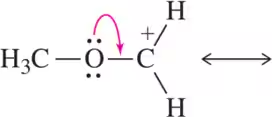
Draw the resonance structure that would result from the indicated movement of electrons.
(a) Resonance structure illustration showing electron movement from oxygen to carbon, with a positive charge on carbon.

Verified step by step guidance
1
Identify the starting structure and locate the electrons that are indicated to move. These could be lone pairs, π-bonds, or negative charges. Ensure you understand the direction of the arrow (from electron source to destination).
Determine the type of resonance movement indicated. Common types include: (1) lone pair to π-bond, (2) π-bond to lone pair, or (3) π-bond to π-bond. This will help you predict the new bonding arrangement.
Redraw the structure, showing the new position of the electrons after the indicated movement. Adjust the formal charges on atoms as necessary to reflect the redistribution of electrons.
Verify that the new structure follows the rules of resonance: (1) the total number of electrons remains the same, (2) the octet rule is satisfied for second-row elements, and (3) the overall charge of the molecule or ion is conserved.
Check for additional resonance structures by repeating the process for other possible electron movements, if applicable. This will help you identify all significant resonance contributors.

Verified video answer for a similar problem:

This video solution was recommended by our tutors as helpful for the problem above.
Video duration:
1m
Was this helpful?

Key Concepts

Here are the essential concepts you must grasp in order to answer the question correctly.

Resonance Structures

Resonance structures are different ways of drawing the same molecule that illustrate the delocalization of electrons. They are used to represent molecules where the electron distribution cannot be depicted by a single Lewis structure. Each resonance structure contributes to the overall hybrid structure, which is more stable than any individual form.
Recommended video:
Guided course
03:04
Drawing Resonance Structures

Electron Movement

Electron movement in organic chemistry typically refers to the shifting of electron pairs during chemical reactions or when drawing resonance structures. This movement is often depicted using arrows, where a double-headed arrow indicates the movement of a pair of electrons, while a single-headed arrow shows the movement of a single electron. Understanding how electrons can move helps in predicting the stability and reactivity of molecules.
Recommended video:
Guided course
01:40
Drawing Electron Movement

Stability of Resonance Structures

The stability of resonance structures is determined by factors such as the octet rule, charge distribution, and the presence of formal charges. More stable resonance structures have full octets for all atoms, minimal formal charges, and negative charges on more electronegative atoms. Evaluating the stability of these structures is crucial for predicting the behavior of molecules in chemical reactions.
Recommended video:
Guided course
03:04
Drawing Resonance Structures