Ch. 2 - General Chemistry Translated: Finding the Electrons
Mullins - Organic Chemistry: A Learner Centered Approach 1st Edition
Mullins1st EditionOrganic Chemistry: A Learner Centered ApproachISBN: 9780137566471Not the one you use?Change textbook
Chapter 1, Problem 75e

For the following partial structures, the σ bond is shown. Add the indicated number of π bonds, being sure to specify the orientation (that is, x, y, or z axis) of the p orbitals used.
(e) Partial molecular structure showing a carbon chain with a σ bond and notation for adding 2 π bonds.

Verified step by step guidance
1
Step 1: Analyze the given structure. The image shows a carbon-carbon single bond (σ bond) with each carbon atom bonded to two hydrogen atoms. The problem asks to add one π bond to the structure.
Step 2: Recall that a π bond is formed by the sideways overlap of p orbitals. For a π bond to exist, each carbon atom must have an unhybridized p orbital available. This typically occurs when the carbon atoms are sp2 hybridized.
Step 3: Adjust the hybridization of the carbon atoms from sp3 (as shown in the image) to sp2. This will leave one unhybridized p orbital on each carbon atom, which can overlap to form the π bond.
Step 4: Specify the orientation of the π bond. The unhybridized p orbitals on the carbon atoms will overlap in a plane perpendicular to the σ bond axis. If the σ bond lies along the x-axis, the π bond will be formed by p orbitals oriented along the y-axis or z-axis.
Step 5: Update the structure to include the π bond. The π bond will be represented as a double bond between the two carbon atoms, indicating the presence of both a σ bond and a π bond in the molecule.

Verified video answer for a similar problem:

This video solution was recommended by our tutors as helpful for the problem above.
Was this helpful?

Key Concepts

Here are the essential concepts you must grasp in order to answer the question correctly.

Pi Bonds

Pi bonds are a type of covalent bond formed by the sideways overlap of p orbitals. They occur in addition to sigma bonds in double and triple bonds, contributing to the overall stability and reactivity of molecules. Understanding the formation and orientation of pi bonds is crucial for predicting molecular geometry and reactivity.
Recommended video:
Guided course
01:05
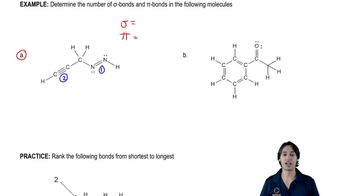
Sigma bonds and pi bonds

Orbital Orientation

The orientation of orbitals refers to the spatial arrangement of atomic orbitals in three-dimensional space. In the context of p orbitals, they can align along the x, y, or z axes, which affects how they overlap with other orbitals to form bonds. Specifying the orientation is essential for accurately depicting molecular structures and predicting their behavior.
Recommended video:
Guided course
08:41
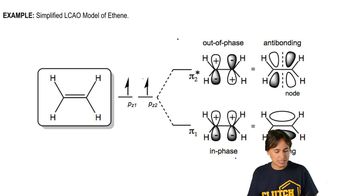
Review of Molecular Orbitals

Molecular Geometry

Molecular geometry describes the three-dimensional arrangement of atoms within a molecule. It is influenced by the types of bonds (sigma and pi) and the orientation of orbitals. Understanding molecular geometry is vital for predicting the physical and chemical properties of substances, including reactivity and polarity.
Recommended video:
Guided course
07:44
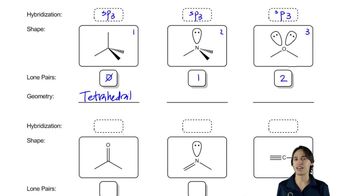
Molecular Geometry Explained.