

Ch. 2 - General Chemistry Translated: Finding the Electrons
Mullins - Organic Chemistry: A Learner Centered Approach 1st Edition
Mullins1st EditionOrganic Chemistry: A Learner Centered ApproachISBN: 9780137566471Not the one you use?Change textbook
Chapter 1, Problem 20d

(i) Using the periodic trend, choose the more electronegative atom in each pair. For one pair, you'll need to look at the actual Pauling values. (ii) For which one? (iii) Why?
(d) B vs. Si

Verified step by step guidance
1
Step 1: Recall the concept of electronegativity, which is the ability of an atom to attract electrons in a chemical bond. Electronegativity generally increases across a period (left to right) and decreases down a group (top to bottom) in the periodic table.
Step 2: Identify the positions of boron (B) and silicon (Si) in the periodic table. Boron is in Group 13 and Period 2, while silicon is in Group 14 and Period 3.
Step 3: Apply the periodic trend. Boron is higher up in the periodic table compared to silicon, and electronegativity decreases as you move down a group. Therefore, boron is expected to be more electronegative than silicon based on its position.
Step 4: For one pair, you are asked to look at the actual Pauling electronegativity values. The Pauling value for boron is approximately 2.04, while for silicon it is approximately 1.90. This confirms that boron is more electronegative than silicon.
Step 5: Explain why boron is more electronegative. Boron is smaller in size compared to silicon, meaning its nucleus has a stronger pull on the bonding electrons due to reduced shielding and closer proximity to the nucleus. This makes boron more effective at attracting electrons in a bond.

Verified video answer for a similar problem:

This video solution was recommended by our tutors as helpful for the problem above.
Video duration:
1m
Was this helpful?

Key Concepts

Here are the essential concepts you must grasp in order to answer the question correctly.

Electronegativity

Electronegativity is a measure of an atom's ability to attract and hold onto electrons in a chemical bond. It is a key concept in understanding how atoms interact in molecules. The Pauling scale is commonly used to quantify electronegativity, with higher values indicating a stronger tendency to attract electrons.
Recommended video:
Guided course
1:47
Electronegativity

Periodic Trends

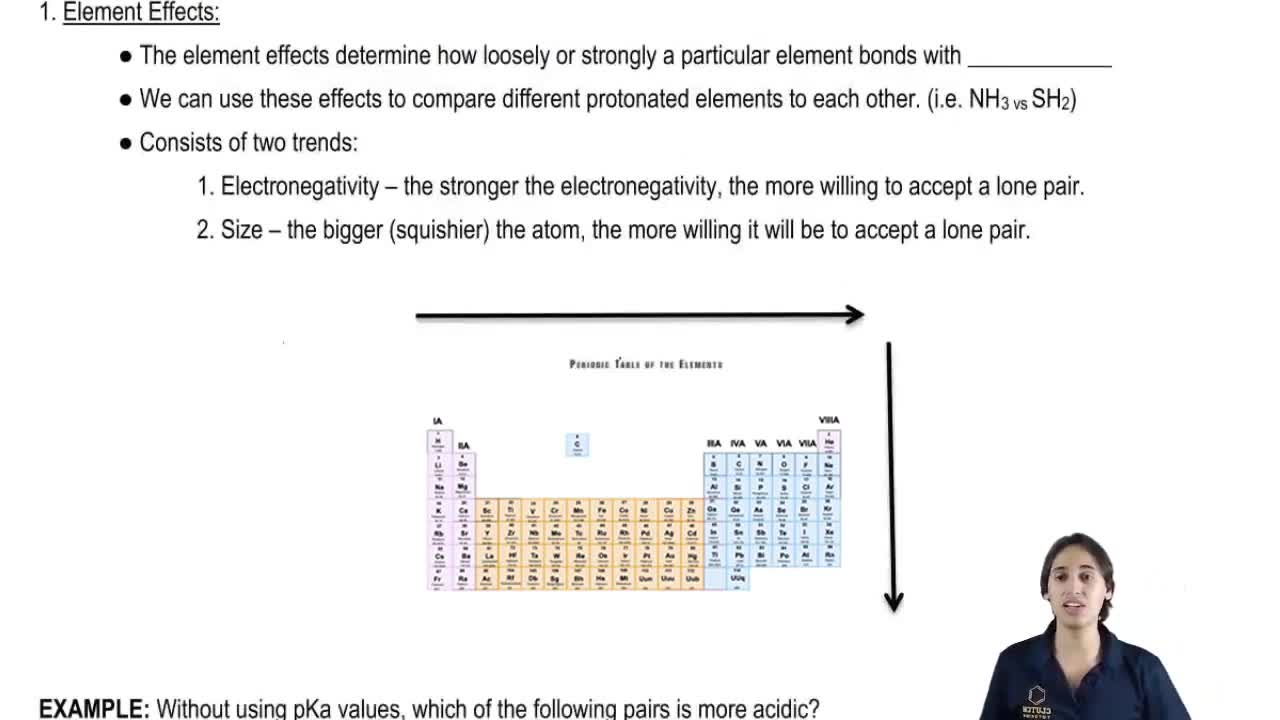
Periodic trends refer to the predictable patterns observed in the properties of elements as you move across or down the periodic table. Electronegativity generally increases across a period from left to right and decreases down a group. This trend is due to the increasing nuclear charge and the effect of electron shielding.
Recommended video:
Guided course
03:43
The radical stability trend.

Comparison of Elements

When comparing two elements, such as boron (B) and silicon (Si), it is essential to consider their positions in the periodic table and their respective electronegativity values. Boron, being higher up in the group, typically has a higher electronegativity than silicon, which can be confirmed by looking at their Pauling values.
Recommended video:
Guided course
06:56
Understanding the Element Effect.