Ch. 2 - General Chemistry Translated: Finding the Electrons
Mullins - Organic Chemistry: A Learner Centered Approach 1st Edition
Mullins1st EditionOrganic Chemistry: A Learner Centered ApproachISBN: 9780137566471Not the one you use?Change textbook
Chapter 1, Problem 18b

Show the ionic compound that you would expect to form between the given metal and nonmetal. Label the charges on each species.
(b) Mg and Br

Verified step by step guidance
1
Step 1: Identify the charges of the metal and nonmetal based on their positions in the periodic table. Magnesium (Mg) is an alkaline earth metal in Group 2, so it typically forms a +2 charge (Mg²⁺). Bromine (Br) is a halogen in Group 17, so it typically forms a -1 charge (Br⁻).
Step 2: Determine the ratio of ions needed to balance the charges. Since Mg²⁺ has a +2 charge and Br⁻ has a -1 charge, two bromide ions are required to balance the charge of one magnesium ion.
Step 3: Write the formula of the ionic compound by combining the ions in the correct ratio. The formula will be MgBr₂, indicating one magnesium ion and two bromide ions.
Step 4: Label the charges on each species in the compound. Magnesium will have a +2 charge (Mg²⁺), and each bromide ion will have a -1 charge (Br⁻).
Step 5: Confirm the neutrality of the compound. The total positive charge from Mg²⁺ is +2, and the total negative charge from two Br⁻ ions is -2, resulting in a neutral compound overall.

Verified video answer for a similar problem:

This video solution was recommended by our tutors as helpful for the problem above.
Was this helpful?

Key Concepts

Here are the essential concepts you must grasp in order to answer the question correctly.

Ionic Bonding

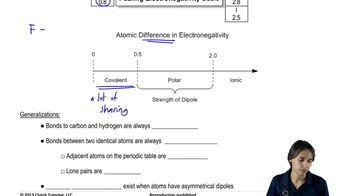
Ionic bonding occurs when electrons are transferred from one atom to another, resulting in the formation of charged ions. Typically, this happens between metals, which lose electrons and become positively charged cations, and nonmetals, which gain electrons to become negatively charged anions. The electrostatic attraction between these oppositely charged ions leads to the formation of an ionic compound.
Recommended video:
Guided course
11:33
Differences between ionic, polar and covalent bonds

Charge of Ions

The charge of ions is determined by the number of electrons lost or gained during the formation of the ionic bond. For example, magnesium (Mg) typically loses two electrons to form a Mg²⁺ ion, while bromine (Br) gains one electron to form a Br⁻ ion. Understanding the charges of the ions is crucial for predicting the formula of the resulting ionic compound.
Recommended video:
3:39
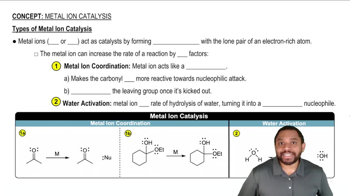
Metal Ion Catalysis Concept 1

Empirical Formula

The empirical formula of an ionic compound represents the simplest whole-number ratio of the ions present in the compound. In the case of magnesium and bromine, the charges of Mg²⁺ and Br⁻ indicate that two bromide ions are needed to balance the charge of one magnesium ion, resulting in the empirical formula MgBr₂. This formula reflects the stoichiometry of the ionic compound formed.
Recommended video:
Guided course
02:17
How to use IHD with molecular formula.