Ch. 22 - Conjugated Systems II: Pericyclic Reactions
Mullins - Organic Chemistry: A Learner Centered Approach 1st Edition
Mullins1st EditionOrganic Chemistry: A Learner Centered ApproachISBN: 9780137566471Not the one you use?Change textbook
Chapter 21, Problem 10

Diene A participates in a fast and efficient Diels–Alder reaction with maleic anhydride, the powerful dienophile from Assessment 22.9. However, the related diene B does not undergo a Diels–Alder reaction. Why?
Diene A reacts with maleic anhydride in a fast Diels-Alder reaction; diene B does not react.

Verified step by step guidance
1
Identify the structural features of diene A and diene B. Diene A should have a conjugated system of double bonds, which is necessary for the Diels–Alder reaction. Diene B may lack this feature.
Examine the stereochemistry and conformation of diene A. For a Diels–Alder reaction to occur, the diene must be in an s-cis conformation, allowing the p orbitals to overlap effectively with the dienophile.
Analyze the electronic properties of diene A and diene B. Diene A should have electron-rich double bonds, which are more reactive towards the electron-poor dienophile, maleic anhydride.
Consider any steric hindrance in diene B that might prevent it from adopting the necessary s-cis conformation or from effectively interacting with the dienophile.
Conclude that diene B does not undergo the Diels–Alder reaction due to its inability to meet one or more of the necessary conditions: lack of conjugation, improper conformation, unfavorable electronic properties, or steric hindrance.

Verified video answer for a similar problem:

This video solution was recommended by our tutors as helpful for the problem above.
Was this helpful?

Key Concepts

Here are the essential concepts you must grasp in order to answer the question correctly.

Diels–Alder Reaction

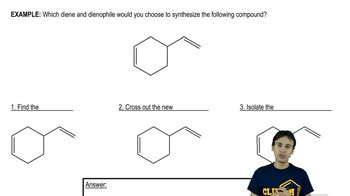
The Diels–Alder reaction is a [4+2] cycloaddition between a conjugated diene and a dienophile, forming a six-membered ring. It is a pericyclic reaction that occurs via a concerted mechanism, requiring the diene to be in an s-cis conformation for effective overlap of p-orbitals. This reaction is stereospecific and often used in synthetic organic chemistry to construct complex cyclic structures.
Recommended video:
Guided course
04:02
Diels-Alder Retrosynthesis

Conformation of Dienes

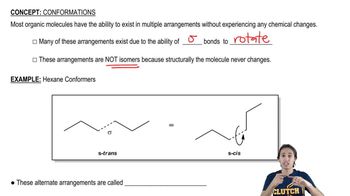
Dienes can exist in s-cis or s-trans conformations, which significantly affect their reactivity in Diels–Alder reactions. The s-cis conformation allows the diene's p-orbitals to align properly with the dienophile, facilitating the cycloaddition. If a diene is locked in an s-trans conformation or cannot easily adopt the s-cis conformation, it will not participate effectively in the Diels–Alder reaction.
Recommended video:
Guided course
03:29
Understanding what a conformer is.

Electronic Effects in Dienes

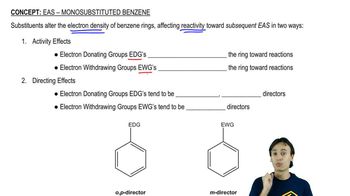
The electronic nature of a diene influences its reactivity in Diels–Alder reactions. Electron-rich dienes are more reactive as they can better interact with electron-deficient dienophiles like maleic anhydride. Substituents on the diene can alter its electron density, affecting its ability to participate in the reaction. Diene B may lack the necessary electronic properties or conformation to react with maleic anhydride.
Recommended video:
Guided course
04:29
Activity and Directing Effects