Ch. 22 - Conjugated Systems II: Pericyclic Reactions
Mullins - Organic Chemistry: A Learner Centered Approach 1st Edition
Mullins1st EditionOrganic Chemistry: A Learner Centered ApproachISBN: 9780137566471Not the one you use?Change textbook
Chapter 21, Problem 37a

For the following electrocyclic reactions, did the substituents move in a conrotatory or disrotatory direction? Would you use heat or light to cause movement in this direction?
(a) Cyclohexadiene ring with substituents moves to a hexatriene ring, indicating an electrocyclic reaction.

Verified step by step guidance
1
Understand the concept of electrocyclic reactions: These are a type of pericyclic reaction where a pi bond is converted into a sigma bond or vice versa, often involving the cyclic movement of electrons.
Identify the type of electrocyclic reaction: Determine whether the reaction is a ring closure or ring opening, as this will influence the direction of substituent movement.
Determine the number of pi electrons involved: The number of pi electrons in the system will dictate whether the reaction proceeds via a conrotatory or disrotatory pathway.
Apply the Woodward-Hoffmann rules: These rules help predict the stereochemistry of electrocyclic reactions. For reactions involving 4n pi electrons, conrotatory motion is favored under thermal conditions, while disrotatory motion is favored under photochemical conditions. For reactions involving 4n+2 pi electrons, the opposite is true.
Decide on the use of heat or light: Based on the number of pi electrons and the desired stereochemical outcome (conrotatory or disrotatory), choose whether to apply heat or light to initiate the reaction.

Verified video answer for a similar problem:

This video solution was recommended by our tutors as helpful for the problem above.
Was this helpful?

Key Concepts

Here are the essential concepts you must grasp in order to answer the question correctly.

Electrocyclic Reactions

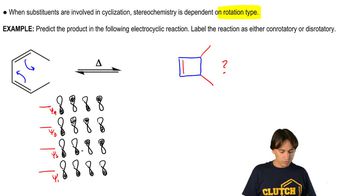
Electrocyclic reactions are a type of pericyclic reaction where a pi-bonded system undergoes a ring closure or opening, resulting in a change in the number of pi bonds. These reactions are stereospecific and can proceed via conrotatory or disrotatory pathways, depending on the number of pi electrons and whether the reaction is thermally or photochemically induced.
Recommended video:
Guided course
08:11
Predicting Electrocyclic Products

Conrotatory and Disrotatory Motion

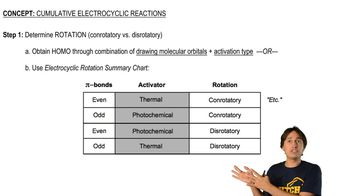
In electrocyclic reactions, conrotatory motion involves the simultaneous rotation of terminal substituents in the same direction, while disrotatory motion involves rotation in opposite directions. The type of motion is determined by the number of pi electrons and the conditions (heat or light) under which the reaction occurs, following the Woodward-Hoffmann rules.
Recommended video:
Guided course
05:51
Two Steps to Predicting Any Electrocyclic Products

Woodward-Hoffmann Rules

The Woodward-Hoffmann rules are a set of principles used to predict the stereochemistry of pericyclic reactions. For electrocyclic reactions, these rules state that reactions with 4n pi electrons proceed conrotatorily under thermal conditions and disrotatorily under photochemical conditions, while those with 4n+2 pi electrons proceed disrotatorily with heat and conrotatorily with light.
Recommended video:
1:18
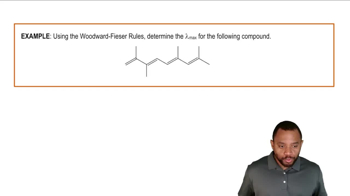
Woodward-Fieser Rules Example 1