Ch. 22 - Conjugated Systems II: Pericyclic Reactions
Mullins - Organic Chemistry: A Learner Centered Approach 1st Edition
Mullins1st EditionOrganic Chemistry: A Learner Centered ApproachISBN: 9780137566471Not the one you use?Change textbook
Chapter 21, Problem 34e

Identify the following dienes as being in the s-cis or s-trans conformation. If they are in the s-trans conformation, draw them in the s-cis conformation. [It may not always be possible.]
(e)

Verified step by step guidance
1
Understand the concept of s-cis and s-trans conformations: In conjugated dienes, the single bond between the two double bonds can rotate, allowing the molecule to adopt different conformations. The s-cis conformation has both double bonds on the same side of the single bond, while the s-trans conformation has them on opposite sides.
Examine the structure of the diene: Look at the arrangement of the double bonds relative to the single bond connecting them. Identify if the double bonds are on the same side (s-cis) or opposite sides (s-trans).
Determine the current conformation: Based on the arrangement, decide if the diene is currently in the s-cis or s-trans conformation.
If the diene is in the s-trans conformation, attempt to visualize or draw it in the s-cis conformation: Rotate the single bond to bring the double bonds to the same side. Note that steric hindrance or other structural constraints may prevent this rotation.
Consider the implications of the conformation: The s-cis conformation is often more reactive in certain reactions, such as Diels-Alder reactions, due to the proximity of the double bonds. Understanding the conformation can help predict reactivity and stability.

Verified video answer for a similar problem:

This video solution was recommended by our tutors as helpful for the problem above.
Was this helpful?

Key Concepts

Here are the essential concepts you must grasp in order to answer the question correctly.

Diene Conformation

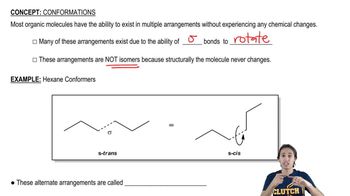
Dienes are hydrocarbons with two double bonds. Their conformation refers to the spatial arrangement of these double bonds. The s-cis conformation has the double bonds on the same side of the single bond connecting them, while the s-trans conformation has them on opposite sides. Understanding these conformations is crucial for predicting the reactivity and stability of dienes.
Recommended video:
Guided course
03:29
Understanding what a conformer is.

Steric Hindrance

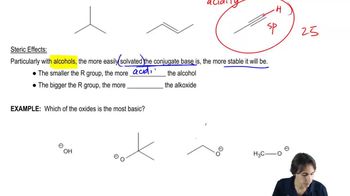
Steric hindrance occurs when the size of groups within a molecule prevents chemical reactions that are otherwise possible. In the context of dienes, steric hindrance can influence whether a diene can adopt an s-cis conformation, as bulky groups may prevent the necessary rotation around the single bond, making the s-trans conformation more stable.
Recommended video:
Guided course
02:53
Understanding steric effects.

Molecular Rotation

Molecular rotation refers to the ability of parts of a molecule to rotate around single bonds. This rotation is essential for converting between s-cis and s-trans conformations in dienes. However, rotation can be restricted by factors such as steric hindrance or the presence of rings, which can lock the molecule in a specific conformation.
Recommended video:
Guided course
08:41
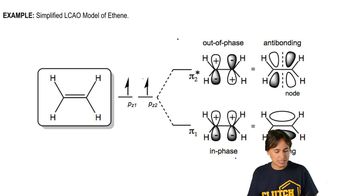
Review of Molecular Orbitals