
Ch. 22 - Conjugated Systems II: Pericyclic Reactions
Mullins - Organic Chemistry: A Learner Centered Approach 1st Edition
Mullins1st EditionOrganic Chemistry: A Learner Centered ApproachISBN: 9780137566471Not the one you use?Change textbook
Chapter 21, Problem 54a

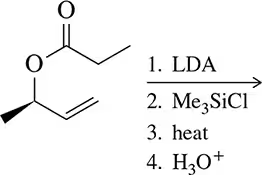
Only after working Assessment 22.53, predict the product of the following reactions.
(a) Chemical reaction diagram showing reactants and conditions: LDA, Me3SiCl, heat, and H3O+ for product prediction.

Verified step by step guidance
1
Identify the starting material as an α,β-unsaturated ester with a ketone group. The structure shows a carbonyl group adjacent to a double bond, which is a common site for enolate formation.
The first reagent, LDA (Lithium diisopropylamide), is a strong, non-nucleophilic base used to deprotonate the most acidic hydrogen. In this case, it will deprotonate the α-hydrogen adjacent to the carbonyl group, forming an enolate ion.
The second step involves Me₃SiCl (Trimethylsilyl chloride), which is used to silylate the enolate ion. This step protects the enolate by forming a silyl enol ether, which is more stable and less reactive than the enolate itself.
Upon heating, the silyl enol ether can undergo a [1,3]-sigmatropic rearrangement or other thermal rearrangements, depending on the specific structure and conditions. This step is crucial for rearranging the molecular structure.
Finally, the addition of H₃O⁺ (acidic workup) will hydrolyze the silyl enol ether back to a ketone or aldehyde, completing the reaction sequence and yielding the final product.

Verified video answer for a similar problem:

This video solution was recommended by our tutors as helpful for the problem above.
Was this helpful?

Key Concepts

Here are the essential concepts you must grasp in order to answer the question correctly.

LDA (Lithium Diisopropylamide) as a Base

LDA is a strong, non-nucleophilic base commonly used in organic synthesis to deprotonate weakly acidic protons, such as those adjacent to carbonyl groups. In this reaction, LDA will likely deprotonate the alpha hydrogen of the ester, generating an enolate ion, which is a key intermediate for further reactions.
Recommended video:
2:50
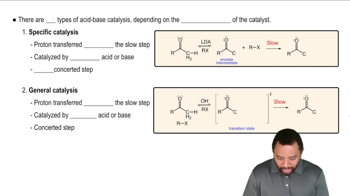
Acid-Base Catalysis Concept 3

Silyl Enol Ether Formation

The reaction with Me3SiCl (trimethylsilyl chloride) following LDA treatment suggests the formation of a silyl enol ether. This occurs when the enolate ion reacts with Me3SiCl, resulting in the protection of the enolate as a silyl enol ether, which is stable and can be used in subsequent reactions without undergoing unwanted side reactions.
Recommended video:
Guided course
02:26
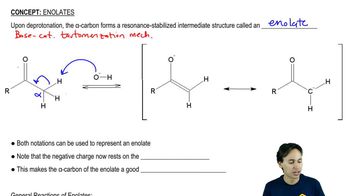
Formation of Enolates

Hydrolysis and Product Formation

The final step involving H3O+ indicates an acidic workup, which typically serves to hydrolyze silyl enol ethers back to their corresponding carbonyl compounds. This step is crucial for regenerating the carbonyl group and completing the transformation, leading to the final product of the reaction sequence.
Recommended video:
1:00
Hydrolysis of Thioesters Concept 2