
Ch. 22 - Conjugated Systems II: Pericyclic Reactions
Mullins - Organic Chemistry: A Learner Centered Approach 1st Edition
Mullins1st EditionOrganic Chemistry: A Learner Centered ApproachISBN: 9780137566471Not the one you use?Change textbook
Chapter 21, Problem 54b

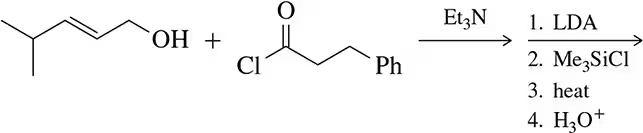
Only after working Assessment 22.53, predict the product of the following reactions.
(b) Chemical reaction diagram showing reactants and steps for predicting product formation.

Verified step by step guidance
1
Identify the reactants: The first reactant is an allylic alcohol, and the second reactant is an acid chloride with a phenyl group.
Step 1 involves the use of LDA (Lithium diisopropylamide), a strong base, which will deprotonate the alcohol to form an alkoxide ion. This step is crucial for the subsequent reaction steps.
Step 2 involves the use of Me3SiCl (Trimethylsilyl chloride), which will protect the alkoxide ion by forming a silyl ether. This protection is necessary to prevent unwanted side reactions.
Step 3 involves heating the reaction mixture. This step is likely to facilitate the nucleophilic attack of the silyl-protected alcohol on the carbonyl carbon of the acid chloride, leading to the formation of an ester linkage.
Step 4 involves the addition of H3O+ (acidic workup), which will remove the silyl protecting group, regenerating the alcohol functionality in the final product.

Verified video answer for a similar problem:

This video solution was recommended by our tutors as helpful for the problem above.
Was this helpful?

Key Concepts

Here are the essential concepts you must grasp in order to answer the question correctly.

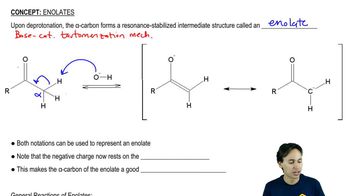
Enolate Formation

Enolate formation is a key step in many organic reactions, involving the deprotonation of an alpha hydrogen adjacent to a carbonyl group. In this reaction, LDA (lithium diisopropylamide) acts as a strong base to deprotonate the alpha position of the carbonyl compound, generating an enolate ion. This enolate can then act as a nucleophile in subsequent steps.
Recommended video:
Guided course
02:26
Formation of Enolates

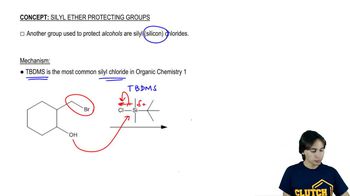
Silyl Ether Protection

Silyl ether protection involves the conversion of an alcohol into a silyl ether, which is more stable and less reactive under certain conditions. In this reaction, Me3SiCl (trimethylsilyl chloride) is used to protect the hydroxyl group of the alcohol, preventing it from interfering in the reaction. This protection is crucial for controlling the reactivity and selectivity of the reaction.
Recommended video:
Guided course
07:16
Mechanism of Silyl Ether Protecting Groups.

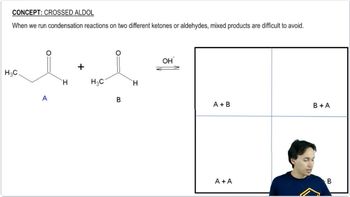
Aldol Condensation

Aldol condensation is a reaction where an enolate ion reacts with a carbonyl compound to form a β-hydroxy ketone or aldehyde, followed by dehydration to yield an α,β-unsaturated carbonyl compound. In this reaction, the enolate formed initially can attack the carbonyl carbon of the other reactant, leading to the formation of a new carbon-carbon bond, which is then followed by dehydration upon heating.
Recommended video:
Guided course
09:51
Crossed Aldol