
Ch. 23 - Benzene I: Aromatic Stability and Substitution Reactions
Mullins - Organic Chemistry: A Learner Centered Approach 1st Edition
Mullins1st EditionOrganic Chemistry: A Learner Centered ApproachISBN: 9780137566471Not the one you use?Change textbook
Chapter 22, Problem 84

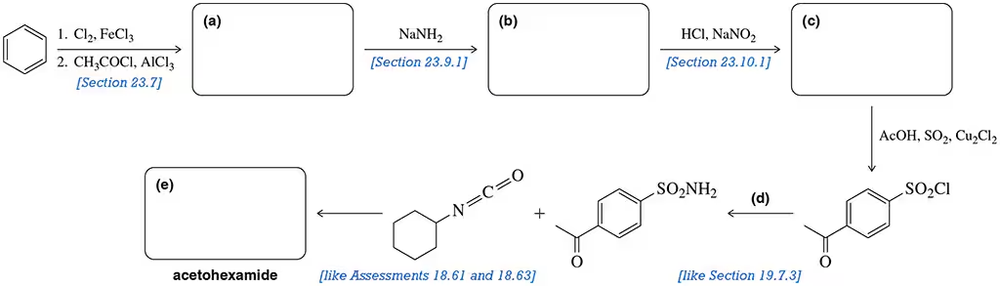
Acetohexamide is used to treat type 2 diabetes that cannot be well controlled by diet alone. Fill in the blanks of the synthetic scheme used to synthesize acetohexamide. [Hints have been provided below each step.]

Verified step by step guidance
1
Step 1: Begin with the chlorination of benzene using Cl₂ and FeCl₃ as a catalyst. This will introduce a chlorine atom onto the benzene ring, forming chlorobenzene.
Step 2: Perform a Friedel-Crafts acylation on chlorobenzene using CH₃COCl and AlCl₃. This will add an acetyl group to the benzene ring, resulting in the formation of 4-chloroacetophenone.
Step 3: Treat 4-chloroacetophenone with NaNH₂. This step involves the conversion of the acetyl group to an amine group, forming 4-chloroaniline.
Step 4: React 4-chloroaniline with HCl and NaNO₂ to form a diazonium salt. This is a key intermediate for further transformations.
Step 5: Convert the diazonium salt to a sulfonyl chloride using AcOH, SO₂, and Cu₂Cl₂. This will yield 4-chlorobenzenesulfonyl chloride, which can then react with cyclohexyl isocyanate to form acetohexamide.

Verified video answer for a similar problem:

This video solution was recommended by our tutors as helpful for the problem above.
Was this helpful?

Key Concepts

Here are the essential concepts you must grasp in order to answer the question correctly.

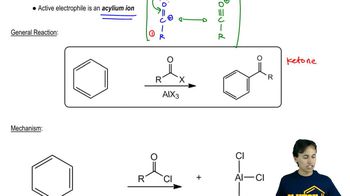
Friedel-Crafts Acylation

Friedel-Crafts acylation is a reaction that introduces an acyl group into an aromatic ring using an acyl chloride and a Lewis acid catalyst, such as AlCl3. This reaction is crucial for forming aromatic ketones, as seen in the initial step of the synthetic scheme for acetohexamide, where benzene is acylated to form an acylated aromatic compound.
Recommended video:
Guided course
05:20
Friedel-Crafts Acylation

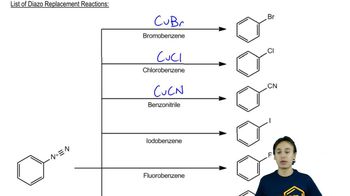
Diazotization and Sandmeyer Reaction

Diazotization involves converting an aromatic amine into a diazonium salt using nitrous acid (HNO2), typically generated in situ from NaNO2 and HCl. The Sandmeyer reaction then allows the transformation of the diazonium group into various functional groups, such as halides or nitriles, using copper(I) salts. This is a key step in modifying aromatic compounds, as seen in the synthetic pathway for acetohexamide.
Recommended video:
Guided course
06:59
Replacement Reactions

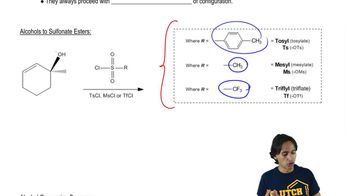
Sulfonyl Chloride Formation and Reaction

Sulfonyl chlorides are formed by reacting aromatic compounds with chlorosulfonic acid or SO2Cl2, often in the presence of a catalyst. These compounds are reactive intermediates that can undergo further reactions, such as nucleophilic substitution, to form sulfonamides. In the synthesis of acetohexamide, the formation and subsequent reaction of a sulfonyl chloride intermediate is a critical step in constructing the final product.
Recommended video:
Guided course
05:33
Learning the mechanism of Sulfonyl Chlorides.