Ch. 23 - Benzene I: Aromatic Stability and Substitution Reactions
Mullins - Organic Chemistry: A Learner Centered Approach 1st Edition
Mullins1st EditionOrganic Chemistry: A Learner Centered ApproachISBN: 9780137566471Not the one you use?Change textbook
Chapter 22, Problem 92

Suggest an arrow-pushing mechanism of the following rearrangement.
Chemical reaction diagram illustrating nucleophilic aromatic substitution with arrow-pushing mechanism and reactants/products labeled.

Verified step by step guidance
1
Identify the functional groups involved in the rearrangement. The starting material contains a sulfonic acid group (SO3H) attached to a phenol group, and the product has a sulfonic acid group attached to an ether linkage.
Recognize the role of the base, NaOH, in the reaction. The hydroxide ion (OH-) can act as a nucleophile and initiate the rearrangement by attacking the sulfonic acid group.
Propose the first step of the mechanism: the hydroxide ion attacks the sulfur atom of the sulfonic acid group, leading to the formation of a negatively charged intermediate where the sulfur atom is bonded to an additional oxygen atom.
Suggest the next step: the negatively charged oxygen atom can facilitate the rearrangement by forming a bond with the adjacent phenolic oxygen, resulting in the cleavage of the S-O bond and formation of the ether linkage.
Conclude the mechanism by showing the final proton transfer step, where the newly formed ether oxygen atom donates a proton to regenerate the sulfonic acid group, completing the rearrangement.

Verified video answer for a similar problem:

This video solution was recommended by our tutors as helpful for the problem above.
Video duration:
9m
Was this helpful?

Key Concepts

Here are the essential concepts you must grasp in order to answer the question correctly.

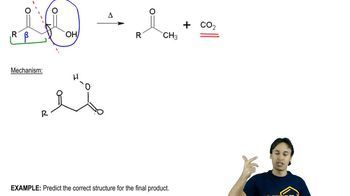
Arrow-Pushing Mechanism

Arrow-pushing mechanisms are a way to illustrate the movement of electrons during chemical reactions. In organic chemistry, these diagrams show how nucleophiles and electrophiles interact, helping to visualize the formation and breaking of bonds. Understanding this concept is crucial for predicting the outcome of reactions and for proposing mechanisms for rearrangements.
Recommended video:
Guided course
04:32
General Mechanism

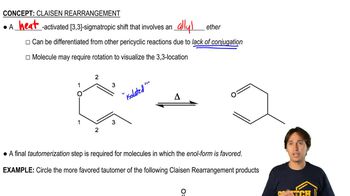
Rearrangement Reactions

Rearrangement reactions involve the structural reorganization of a molecule, resulting in the formation of an isomer. These reactions often occur through the migration of atoms or groups within the molecule, influenced by factors such as stability and sterics. Recognizing the type of rearrangement and the stability of intermediates is essential for proposing accurate mechanisms.
Recommended video:
Guided course
06:08
Definition of Claisen Rearrangement

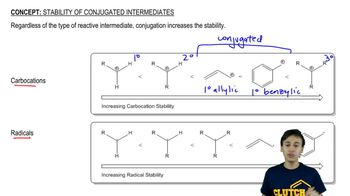
Stability of Intermediates

The stability of intermediates, such as carbocations or carbanions, plays a critical role in determining the pathway of a rearrangement reaction. More stable intermediates are favored and can lead to faster reaction rates. Understanding the factors that influence stability, such as resonance and inductive effects, is vital for predicting the mechanism and products of the rearrangement.
Recommended video:
Guided course
04:31
Stability of Conjugated Intermediates