
Ch. 24 - Benzene II: Reactions Influenced by the Aromatic Ring
Mullins - Organic Chemistry: A Learner Centered Approach 1st Edition
Mullins1st EditionOrganic Chemistry: A Learner Centered ApproachISBN: 9780137566471Not the one you use?Change textbook
Chapter 23, Problem 4

Calculate the oxidation number of the indicated atoms in the following reaction.
Chemical reaction showing oxidation of benzyl alcohol to benzoic acid using KMnO4, KOH, H2O, and H3O+ quench.

Verified step by step guidance
1
Identify the atoms in the reaction for which you need to calculate the oxidation numbers. Typically, these are the atoms that undergo a change in oxidation state during the reaction.
Recall the general rules for assigning oxidation numbers: (1) The oxidation number of an atom in its elemental form is 0. (2) For monoatomic ions, the oxidation number is equal to the charge of the ion. (3) Oxygen usually has an oxidation number of -2, and hydrogen usually has +1. (4) The sum of oxidation numbers in a neutral compound is 0, and in a polyatomic ion, it is equal to the ion's charge.
Apply these rules to assign oxidation numbers to each atom in the reactants and products. Start with atoms that have known oxidation states, such as oxygen and hydrogen, to help deduce the oxidation states of other atoms.
Compare the oxidation numbers of the indicated atoms in the reactants and products. Determine if there is an increase or decrease in the oxidation number, which indicates oxidation or reduction, respectively.
Summarize the changes in oxidation numbers to identify which atoms are oxidized and which are reduced. This will help in understanding the redox process occurring in the reaction.

Verified video answer for a similar problem:

This video solution was recommended by our tutors as helpful for the problem above.
Was this helpful?

Key Concepts

Here are the essential concepts you must grasp in order to answer the question correctly.

Oxidation Number

The oxidation number, or oxidation state, is a theoretical charge assigned to an atom in a molecule or ion, reflecting its degree of oxidation. It helps in tracking electron transfer in redox reactions. The rules for determining oxidation numbers include assigning -2 to oxygen, +1 to hydrogen, and using the charge of ions to deduce the oxidation states of other elements.
Recommended video:
Guided course
03:40
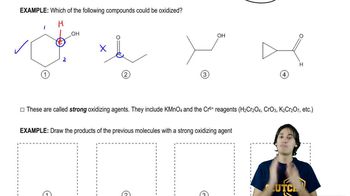
Strong oxidizing agents

Redox Reactions

Redox reactions involve the transfer of electrons between two species, leading to changes in their oxidation states. Oxidation refers to the loss of electrons, while reduction refers to the gain of electrons. Understanding redox reactions is crucial for calculating oxidation numbers, as it helps identify which atoms are oxidized and which are reduced.
Recommended video:
Guided course
06:02
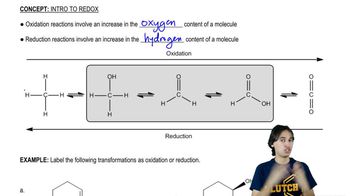
General Features of Redox

Balancing Chemical Equations

Balancing chemical equations ensures that the number of atoms for each element is equal on both sides of the reaction, maintaining the law of conservation of mass. In redox reactions, balancing also involves ensuring that the total increase in oxidation numbers equals the total decrease, which is essential for accurately determining the oxidation states of atoms.
Recommended video:
3:11
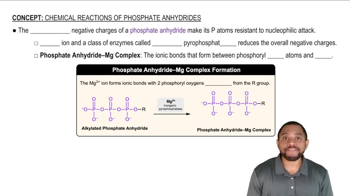
Chemical Reactions of Phosphate Anhydrides Concept 1