

Ch. 24 - Benzene II: Reactions Influenced by the Aromatic Ring
Mullins - Organic Chemistry: A Learner Centered Approach 1st Edition
Mullins1st EditionOrganic Chemistry: A Learner Centered ApproachISBN: 9780137566471Not the one you use?Change textbook
Chapter 23, Problem 6

What is the product of the following reaction?
Chemical reaction diagram showing an alcohol reacting with sodium and a bromide to form an ether product.

Verified step by step guidance
1
Identify the starting material as an alcohol, specifically propanol, which has the structure \( \text{CH}_3\text{CH}_2\text{CH}_2\text{OH} \).
Recognize that the first reagent, \( \text{Na}^0 \), is metallic sodium. This will react with the alcohol to form an alkoxide ion by deprotonating the hydroxyl group.
Write the reaction of propanol with sodium: \( \text{CH}_3\text{CH}_2\text{CH}_2\text{OH} + \text{Na} \rightarrow \text{CH}_3\text{CH}_2\text{CH}_2\text{O}^-\text{Na}^+ + \frac{1}{2}\text{H}_2 \). This forms sodium propoxide.
Consider the second step, which involves the reaction of the sodium propoxide with 2-bromobutane. This is a nucleophilic substitution reaction where the alkoxide ion acts as a nucleophile.
Predict the product of the nucleophilic substitution: the alkoxide ion \( \text{CH}_3\text{CH}_2\text{CH}_2\text{O}^- \) will attack the electrophilic carbon in 2-bromobutane, displacing the bromide ion and forming an ether, specifically butyl propyl ether.

Verified video answer for a similar problem:

This video solution was recommended by our tutors as helpful for the problem above.
Was this helpful?

Key Concepts

Here are the essential concepts you must grasp in order to answer the question correctly.

Reaction Mechanisms

Understanding reaction mechanisms is crucial in organic chemistry as they describe the step-by-step process by which reactants transform into products. This includes identifying intermediates, transition states, and the movement of electrons. A clear grasp of mechanisms helps predict the outcome of reactions and the stability of products formed.
Recommended video:
Guided course
02:16
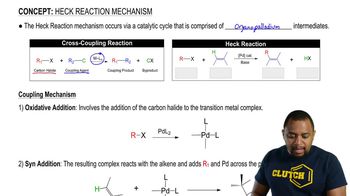
Heck Reaction Mechanism

Functional Groups

Functional groups are specific groups of atoms within molecules that are responsible for the characteristic chemical reactions of those molecules. Recognizing functional groups allows chemists to predict reactivity and the types of products that can be formed in a reaction. Common functional groups include alcohols, carboxylic acids, and amines.
Recommended video:
Guided course
02:36
Identifying Functional Groups

Stereochemistry

Stereochemistry involves the study of the spatial arrangement of atoms in molecules and how this affects their chemical behavior. It is essential for understanding isomerism, where compounds with the same molecular formula can have different structures and properties. Stereochemical considerations can significantly influence the outcome of reactions, especially in chiral environments.
Recommended video:
1:38
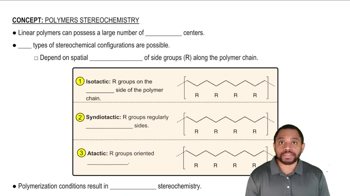
Polymer Stereochemistry Concept 1