Ch. 24 - Benzene II: Reactions Influenced by the Aromatic Ring
Mullins - Organic Chemistry: A Learner Centered Approach 1st Edition
Mullins1st EditionOrganic Chemistry: A Learner Centered ApproachISBN: 9780137566471Not the one you use?Change textbook
Chapter 23, Problem 57a

Phenol oxidation can be coupled with other reactions to form new C―C bonds using reactions studied previously. Predict the product of the following series of reactions.
(a) Chemical reaction diagram showing phenol oxidation with H2CrO4 and heat to predict product formation.

Verified step by step guidance
1
Identify the starting material as hydroquinone, which is a benzene ring with two hydroxyl groups (OH) in the para position.
Recognize that the first reagent, H₂CrO₄ (chromic acid), is a strong oxidizing agent. It will oxidize the hydroquinone to para-benzoquinone, converting the hydroxyl groups to carbonyl groups (C=O).
Understand that the second step involves the reaction of para-benzoquinone with cyclopentadiene in the presence of heat. This is a Diels-Alder reaction, where the diene (cyclopentadiene) reacts with the dienophile (para-benzoquinone).
In the Diels-Alder reaction, the diene and dienophile form a new six-membered ring. The reaction will result in the formation of a bicyclic compound, where the cyclopentadiene adds across the double bonds of the quinone.
Consider the stereochemistry and regiochemistry of the Diels-Alder reaction, which typically proceeds with endo selectivity, meaning the newly formed bridge will be oriented towards the electron-withdrawing groups of the dienophile.

Verified video answer for a similar problem:

This video solution was recommended by our tutors as helpful for the problem above.
Video duration:
8m
Was this helpful?

Key Concepts

Here are the essential concepts you must grasp in order to answer the question correctly.

Phenol Structure and Reactivity

Phenol is an aromatic compound with a hydroxyl (-OH) group attached to a benzene ring. Its structure allows for unique reactivity, particularly in electrophilic aromatic substitution and oxidation reactions. Understanding how the hydroxyl group influences the electron density of the aromatic ring is crucial for predicting the outcomes of reactions involving phenol.
Recommended video:
Guided course
02:27
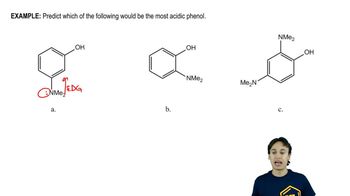
Identify the most acidic phenol

Oxidation Reactions

Oxidation reactions involve the loss of electrons or an increase in oxidation state, often resulting in the formation of new functional groups. In the context of phenol, oxidation can lead to the formation of quinones, which are highly reactive and can participate in further reactions, including coupling with other substrates to form new carbon-carbon bonds.
Recommended video:
Guided course
03:20
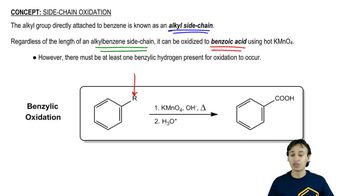
Benzylic Oxidation

C―C Bond Formation

C―C bond formation is a fundamental aspect of organic synthesis, allowing for the construction of complex molecules. Various methods, such as cross-coupling reactions, can be employed to create these bonds. Understanding the mechanisms and conditions under which these reactions occur is essential for predicting the products of reactions involving phenol and its oxidized derivatives.
Recommended video:
3:15
Disulfide Bonds Example 2