Ch. 24 - Benzene II: Reactions Influenced by the Aromatic Ring
Mullins - Organic Chemistry: A Learner Centered Approach 1st Edition
Mullins1st EditionOrganic Chemistry: A Learner Centered ApproachISBN: 9780137566471Not the one you use?Change textbook
Chapter 23, Problem 56

In light of your answers to Assessments 24.54 and 24.55, rank the following based on the rate of protonation of the alkene (1 = most basic, 6 = least basic). [Ignore the fact that the alkene may not be the most basic site in the molecule.]
Chemical structures of six compounds for ranking acidity based on protonation rates, labeled with Cl, H3C, N, H, O, and O2N.

Verified step by step guidance
1
Analyze the substituents attached to the benzene ring in each molecule. Substituents can influence the electron density of the alkene through inductive effects or resonance effects, which affect the basicity of the alkene.
Consider the electron-donating or electron-withdrawing nature of each substituent. Electron-donating groups (e.g., alkyl groups) increase electron density on the alkene, making it more basic, while electron-withdrawing groups (e.g., nitro groups) decrease electron density, making the alkene less basic.
Rank the molecules based on the substituents: (1) The molecule with the strongest electron-donating group will have the most basic alkene. (2) The molecule with the strongest electron-withdrawing group will have the least basic alkene.
Evaluate the substituents: -CH3 (electron-donating), -Cl (weak electron-withdrawing), -H (neutral), -N(CH3) (electron-donating due to lone pair resonance), -C=O (strong electron-withdrawing), -NO2 (very strong electron-withdrawing).
Assign ranks based on the above analysis: (1 = most basic, 6 = least basic). Molecules with electron-donating groups will rank higher, while those with electron-withdrawing groups will rank lower.

Verified video answer for a similar problem:

This video solution was recommended by our tutors as helpful for the problem above.
Video duration:
7m
Was this helpful?

Key Concepts

Here are the essential concepts you must grasp in order to answer the question correctly.

Protonation of Alkenes

Protonation of alkenes involves the addition of a proton (H+) to the double bond, forming a carbocation. The stability of the resulting carbocation significantly influences the rate of protonation. More stable carbocations, such as tertiary ones, are formed more readily, making the corresponding alkene more basic. Understanding the factors that stabilize carbocations is crucial for predicting protonation rates.
Recommended video:
2:09
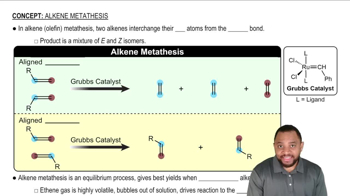
Alkene Metathesis Concept 1

Electronic Effects of Substituents

The presence of different substituents on an alkene can greatly affect its basicity and the rate of protonation. Electron-donating groups (EDGs) enhance basicity by stabilizing the positive charge of the carbocation, while electron-withdrawing groups (EWGs) decrease basicity by destabilizing it. Recognizing how these groups influence electron density is essential for ranking the alkenes based on their protonation rates.
Recommended video:
2:02
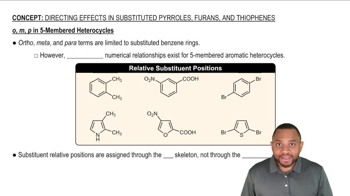
Directing Effects in Substituted Pyrroles, Furans, and Thiophenes Concept 1

Resonance Stabilization

Resonance stabilization occurs when a molecule can be represented by multiple valid Lewis structures, distributing electron density over several atoms. In the context of alkenes, substituents that can participate in resonance can stabilize the carbocation formed during protonation. This stabilization can significantly enhance the basicity of the alkene, making it more favorable for protonation compared to alkenes without such resonance effects.
Recommended video:
Guided course
03:43
The radical stability trend.