Ch. 24 - Benzene II: Reactions Influenced by the Aromatic Ring
Mullins - Organic Chemistry: A Learner Centered Approach 1st Edition
Mullins1st EditionOrganic Chemistry: A Learner Centered ApproachISBN: 9780137566471Not the one you use?Change textbook
Chapter 23, Problem 33b

Predict the product of the following reactions.
(b)

Verified step by step guidance
1
Identify the functional groups present in the molecule. The structure contains an amide group, an ether linkage, and a benzene ring.
Recognize the reagents used in the reaction: H2 and Pd0. This combination is typically used for hydrogenation reactions, which can reduce double bonds and other unsaturated systems.
Determine the parts of the molecule that can be affected by hydrogenation. In this case, the benzene ring is a potential site for hydrogenation, as it can be reduced to a cyclohexane ring under certain conditions.
Consider the stability and reactivity of the functional groups. The amide group is generally stable under hydrogenation conditions, so it is unlikely to be reduced.
Predict the product by considering the reduction of the benzene ring to a cyclohexane ring, while the rest of the molecule remains unchanged. The ether linkage and the amide group should remain intact.

Verified video answer for a similar problem:

This video solution was recommended by our tutors as helpful for the problem above.
Was this helpful?

Key Concepts

Here are the essential concepts you must grasp in order to answer the question correctly.

Catalytic Hydrogenation

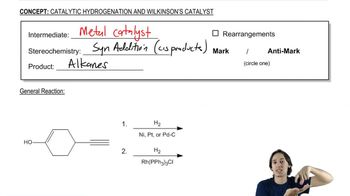
Catalytic hydrogenation involves the addition of hydrogen (H2) to unsaturated bonds, typically using a metal catalyst like palladium (Pd). This process converts alkenes and alkynes into alkanes by breaking double or triple bonds, resulting in a saturated compound. In the given reaction, Pd0 acts as the catalyst facilitating the hydrogenation of any unsaturated bonds present in the molecule.
Recommended video:
Guided course
05:21
General properties of catalytic hydrogenation.

Amide Functional Group

An amide is a functional group characterized by a carbonyl group (C=O) linked to a nitrogen atom (N). Amides are generally stable and resistant to hydrogenation under typical conditions, meaning they usually remain unchanged in reactions involving hydrogen and metal catalysts. In the given structure, the amide group is unlikely to be affected by the hydrogenation process.
Recommended video:
Guided course
02:36
Identifying Functional Groups

Aromatic Stability

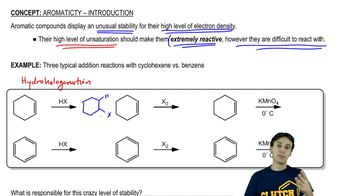
Aromatic compounds, like benzene rings, exhibit exceptional stability due to resonance, where electrons are delocalized across the ring structure. This stability makes aromatic rings resistant to hydrogenation under standard conditions. In the reaction, the benzene ring is expected to remain intact, as hydrogenation typically does not disrupt aromatic systems without specific conditions.
Recommended video:
Guided course
08:19
Intro to Aromaticity