Ch. 24 - Benzene II: Reactions Influenced by the Aromatic Ring
Mullins - Organic Chemistry: A Learner Centered Approach 1st Edition
Mullins1st EditionOrganic Chemistry: A Learner Centered ApproachISBN: 9780137566471Not the one you use?Change textbook
Chapter 23, Problem 32a

Predict the product of the following series of reactions.
(a) Chemical reaction diagram showing a benzene derivative with reagents for side-chain oxidation and product prediction.

Verified step by step guidance
1
Identify the starting material: The structure shown is an alkyl benzene with a tert-butyl group and an ethyl group attached to the benzene ring.
Analyze the first reaction condition: The use of H₂CrO₄ (chromic acid) in the presence of heat and water indicates an oxidation reaction. Chromic acid is a strong oxidizing agent that typically oxidizes primary alcohols to carboxylic acids and secondary alcohols to ketones. In the case of alkyl benzenes, it can oxidize the benzylic position to a carboxylic acid.
Predict the product of the first reaction: The ethyl group attached to the benzene ring is at the benzylic position, which is susceptible to oxidation by chromic acid. The ethyl group will be oxidized to a carboxylic acid, resulting in benzoic acid with a tert-butyl group still attached to the benzene ring.
Analyze the second reaction condition: The presence of ethanol (CH₃CH₂OH) and sulfuric acid (H₂SO₄) suggests an esterification reaction. Sulfuric acid acts as a catalyst in the formation of esters from carboxylic acids and alcohols.
Predict the product of the second reaction: The carboxylic acid formed in the first step will react with ethanol in the presence of sulfuric acid to form an ester. The product will be an ester with the tert-butyl group still attached to the benzene ring.

Verified video answer for a similar problem:

This video solution was recommended by our tutors as helpful for the problem above.
Was this helpful?

Key Concepts

Here are the essential concepts you must grasp in order to answer the question correctly.

Side-Chain Oxidation of Alkylbenzenes

Side-chain oxidation of alkylbenzenes involves the conversion of the alkyl group attached to a benzene ring into a carboxylic acid. This reaction typically uses strong oxidizing agents like chromic acid (H2CrO4) in the presence of heat. The reaction proceeds through the formation of a benzylic radical or cation, which is then oxidized to the carboxylic acid, regardless of the length of the alkyl chain.
Recommended video:
Guided course
06:14
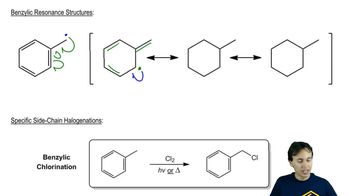
Side-Chain Halogenations

Chromic Acid Oxidation

Chromic acid (H2CrO4) is a powerful oxidizing agent used to oxidize primary alcohols to carboxylic acids and secondary alcohols to ketones. In the context of alkylbenzenes, chromic acid can oxidize the benzylic carbon, converting it into a carboxylic acid. This reaction is facilitated by the presence of water and heat, which help in the formation of the oxidizing species and the subsequent reaction steps.
Recommended video:
Guided course
04:15
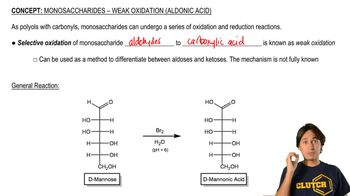
Monosaccharides - Weak Oxidation (Aldonic Acid)

Esterification Reaction

Esterification is a chemical reaction between an alcohol and a carboxylic acid to form an ester and water. In the presence of an acid catalyst like sulfuric acid (H2SO4), the carboxylic acid formed from the oxidation of the alkylbenzene can react with an alcohol, such as ethanol, to form an ester. This reaction involves the nucleophilic attack of the alcohol on the carbonyl carbon of the acid, followed by the elimination of water.
Recommended video:
1:21
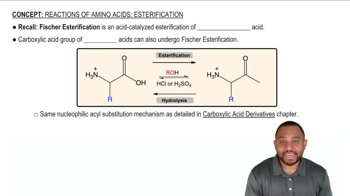
Reactions of Amino Acids: Esterification Concept 1