Ch. 25 - Amines: Structure, Reactions, and Synthesis
Mullins - Organic Chemistry: A Learner Centered Approach 1st Edition
Mullins1st EditionOrganic Chemistry: A Learner Centered ApproachISBN: 9780137566471Not the one you use?Change textbook
Chapter 24, Problem 31b

Following a LiAlH₄ reduction, an IR spectrum suggested that the product was a mixture of the starting amide and the desired amine.
(b) Once separated, how could you distinguish between the amide and the amine using IR spectroscopy?
Chemical reaction showing LiAlH₄ reducing an amide to an amine.

Verified step by step guidance
1
Understand the functional groups involved: Amides typically have a carbonyl group (C=O) and an N-H bond, while amines have N-H bonds but lack the carbonyl group.
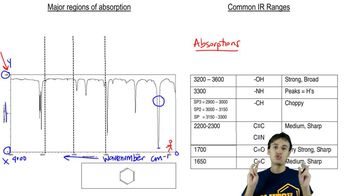
Identify the characteristic IR absorption peaks: Amides show a strong absorption band for the carbonyl group (C=O) around 1650-1700 cm-1 and N-H stretching vibrations around 3200-3500 cm-1.
Recognize the absence of the carbonyl peak in amines: Amines will not show the carbonyl peak around 1650-1700 cm-1 but will have N-H stretching vibrations, which can appear as one or two peaks depending on whether the amine is primary or secondary.
Compare the IR spectra: Look for the presence of the carbonyl peak to identify the amide. The absence of this peak, along with the presence of N-H stretching, indicates the amine.
Confirm the identity: Use the presence or absence of the carbonyl peak as the primary distinguishing feature between the amide and the amine in the IR spectrum.

Verified video answer for a similar problem:

This video solution was recommended by our tutors as helpful for the problem above.
Was this helpful?

Key Concepts

Here are the essential concepts you must grasp in order to answer the question correctly.

IR Spectroscopy

Infrared (IR) spectroscopy is a technique used to identify functional groups in organic compounds by measuring the absorption of infrared light. Different bonds absorb specific frequencies, allowing for the identification of molecular structures. In this context, IR spectroscopy helps distinguish between amides and amines based on their characteristic absorption bands.
Recommended video:
Guided course
16:04
General Features of IR Spect

Amide Functional Group

Amides are organic compounds characterized by the presence of a carbonyl group (C=O) linked to a nitrogen atom. In IR spectroscopy, amides typically show a strong absorption band around 1650-1700 cm⁻¹ due to the C=O stretch. Additionally, N-H stretching vibrations can appear around 3300-3500 cm⁻¹, which helps differentiate them from amines.
Recommended video:
Guided course
02:36
Identifying Functional Groups

Amine Functional Group

Amines are organic compounds containing a nitrogen atom bonded to hydrogen atoms or carbon chains. In IR spectroscopy, primary amines exhibit N-H stretching vibrations around 3300-3500 cm⁻¹, often appearing as two peaks due to symmetric and asymmetric stretching. Unlike amides, amines lack the C=O stretch, which is a key distinguishing feature.
Recommended video:
Guided course
02:36
Identifying Functional Groups