Ch. 25 - Amines: Structure, Reactions, and Synthesis
Mullins - Organic Chemistry: A Learner Centered Approach 1st Edition
Mullins1st EditionOrganic Chemistry: A Learner Centered ApproachISBN: 9780137566471Not the one you use?Change textbook
Chapter 24, Problem 29

The nitro group directs electrophilic aromatic substitution to the meta position. After reduction by hydrogenation, to which carbon(s) does it direct?

Verified step by step guidance
1
Understand that the nitro group (NO₂) is a strong electron-withdrawing group due to its resonance and inductive effects, making it a meta-director in electrophilic aromatic substitution reactions.
In the presence of an electrophile (E⁺), the nitro group directs the incoming electrophile to the meta position relative to itself on the benzene ring. This is because the ortho and para positions are destabilized by the positive charge in the resonance structures.
Consider the reduction of the nitro group by hydrogenation. This process typically converts the nitro group (NO₂) into an amino group (NH₂).
Recognize that the amino group (NH₂) is an electron-donating group due to its lone pair of electrons, which makes it an ortho/para director in electrophilic aromatic substitution reactions.
After reduction, the amino group will direct electrophiles to the ortho and para positions relative to itself on the benzene ring, as these positions are stabilized by resonance with the lone pair on the nitrogen.

Verified video answer for a similar problem:

This video solution was recommended by our tutors as helpful for the problem above.
Was this helpful?

Key Concepts

Here are the essential concepts you must grasp in order to answer the question correctly.

Electrophilic Aromatic Substitution (EAS)

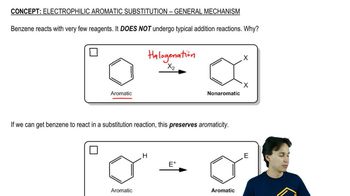
Electrophilic Aromatic Substitution is a fundamental reaction in organic chemistry where an electrophile replaces a hydrogen atom on an aromatic ring. The position of substitution is influenced by the nature of substituents already present on the ring, which can either activate or deactivate the ring towards further substitution.
Recommended video:

Directing Effects of Substituents

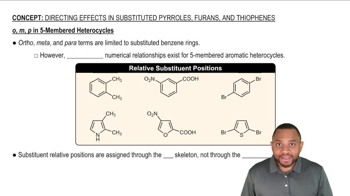
Substituents on an aromatic ring can direct incoming electrophiles to specific positions during EAS. The nitro group (-NO2) is a strong electron-withdrawing group that directs substitution to the meta position due to its resonance and inductive effects, which destabilize the ortho and para positions.
Recommended video:
2:02
Directing Effects in Substituted Pyrroles, Furans, and Thiophenes Concept 1

Reduction of Nitro Groups

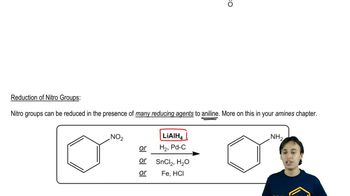
The reduction of nitro groups typically converts them into amine groups (-NH2). This transformation alters the electronic properties of the aromatic ring, changing the directing effects. Amines are electron-donating groups that direct electrophilic substitution to the ortho and para positions, contrasting with the meta-directing nature of the nitro group.
Recommended video:
Guided course
03:23
Reduction of Nitro Groups