Ch. 27 - Carbohydrates, Nucleic Acids, and Lipids
Mullins - Organic Chemistry: A Learner Centered Approach 1st Edition
Mullins1st EditionOrganic Chemistry: A Learner Centered ApproachISBN: 9780137566471Not the one you use?Change textbook
Chapter 26, Problem 14

Which of the following molecule pairs are epimers?
(a) Structural formulas of two carbohydrate molecules, highlighting their differences to illustrate epimerization.
(b)
(c)

Verified step by step guidance
1
Understand the definition of epimers: Epimers are a type of stereoisomer where two molecules differ in configuration at only one stereogenic center.
Examine the first pair of molecules: Look at the Fischer projections provided. Identify the stereogenic centers and compare the configuration at each center.
Examine the second pair of molecules: Look at the cyclic structures provided. Identify the stereogenic centers and compare the configuration at each center.
Examine the third pair of molecules: Look at the cyclic structures provided. Identify the stereogenic centers and compare the configuration at each center.
Determine which pair of molecules differ at only one stereogenic center, confirming they are epimers. This involves checking each pair for differences in configuration at only one stereogenic center.

Verified video answer for a similar problem:

This video solution was recommended by our tutors as helpful for the problem above.
Video duration:
2m
Was this helpful?

Key Concepts

Here are the essential concepts you must grasp in order to answer the question correctly.

Epimers

Epimers are a type of stereoisomer where two molecules differ only in the configuration around one specific carbon atom. This difference occurs at a single chiral center, making epimers a subset of diastereomers. Understanding epimers is crucial for distinguishing between molecules that have similar structures but different spatial arrangements, which can significantly affect their chemical properties and biological functions.
Recommended video:
Guided course
03:42
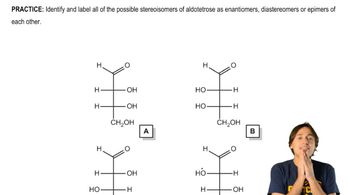
Identifying Types of Stereoisomers

Chirality and Chiral Centers

Chirality refers to the geometric property of a molecule having a non-superimposable mirror image, much like left and right hands. A chiral center, often a carbon atom, is bonded to four different groups, leading to two possible configurations (R or S). Identifying chiral centers is essential for understanding stereochemistry and the behavior of molecules in biological systems, as these centers determine the molecule's three-dimensional shape and interactions.
Recommended video:
Guided course
05:10
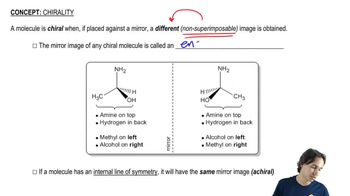
What is chirality?

Stereochemistry

Stereochemistry involves the study of the spatial arrangement of atoms in molecules and how this affects their chemical behavior. It is crucial for understanding isomerism, including enantiomers and diastereomers, which have the same molecular formula but differ in the orientation of their atoms. Stereochemistry is fundamental in organic chemistry, as it influences the physical and chemical properties of compounds, including reactivity and interaction with biological molecules.
Recommended video:
1:38
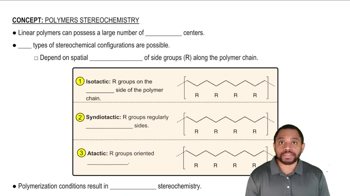
Polymer Stereochemistry Concept 1