Ch. 27 - Carbohydrates, Nucleic Acids, and Lipids
Mullins - Organic Chemistry: A Learner Centered Approach 1st Edition
Mullins1st EditionOrganic Chemistry: A Learner Centered ApproachISBN: 9780137566471Not the one you use?Change textbook
Chapter 26, Problem 16

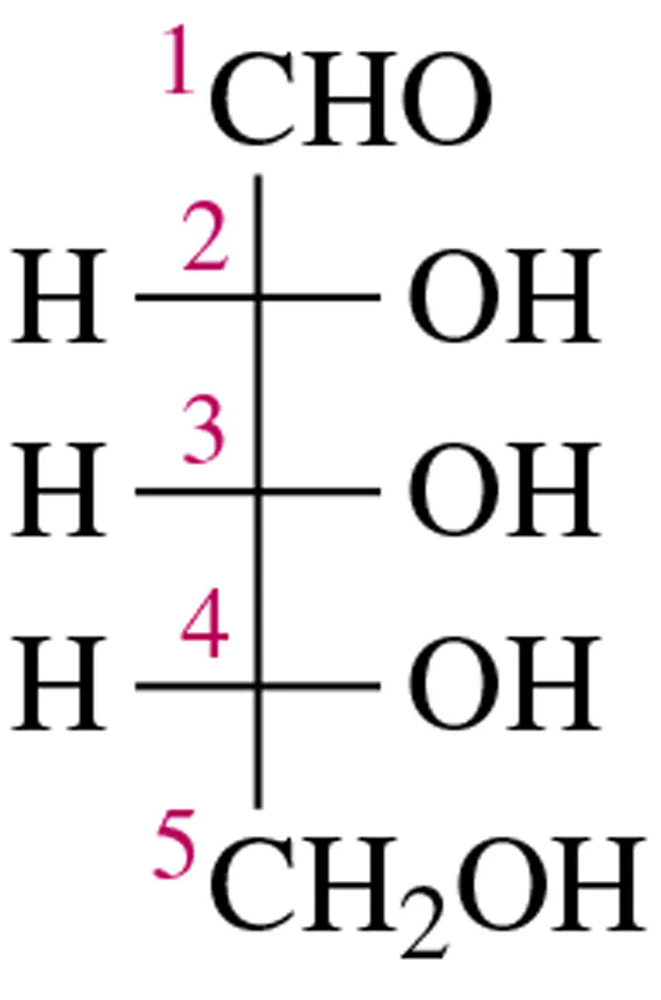
Using the Haworth projection, draw the furanose ring that would form between the C4 hydroxyl group and the aldehyde at C1 for the molecule shown.
Structural representation of a monosaccharide with labeled carbon atoms and functional groups for Haworth projection.

Verified step by step guidance
1
Identify the functional groups involved in the ring formation. The C1 has an aldehyde group (CHO), and the C4 has a hydroxyl group (OH).
Understand that the furanose ring is a five-membered ring structure. In this case, the ring will form between the C1 aldehyde and the C4 hydroxyl group.
To form the furanose ring, the oxygen from the C4 hydroxyl group will attack the carbonyl carbon of the C1 aldehyde, forming a hemiacetal linkage.
Draw the five-membered ring structure. Place the oxygen atom from the C4 hydroxyl group as part of the ring, and connect it to the C1 carbon, which now has an OH group as a result of the hemiacetal formation.
Complete the Haworth projection by arranging the remaining carbon atoms (C2, C3, and C5) around the ring. Ensure that the substituents (OH and CH2OH groups) are placed correctly according to their original stereochemistry in the linear form.

Verified video answer for a similar problem:

This video solution was recommended by our tutors as helpful for the problem above.
Video duration:
3m
Was this helpful?

Key Concepts

Here are the essential concepts you must grasp in order to answer the question correctly.

Haworth Projection

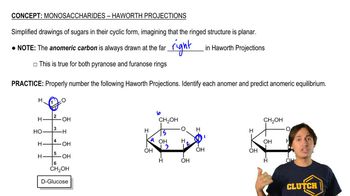
The Haworth projection is a way of representing cyclic sugars in a two-dimensional format that illustrates the cyclic structure of monosaccharides. It shows the orientation of the hydroxyl groups and other substituents around the ring, making it easier to visualize the three-dimensional conformation of the molecule. This representation is particularly useful for understanding the anomeric carbon and the formation of glycosidic bonds.
Recommended video:
Guided course
04:03
Monosaccharides - Haworth Projections

Furanose Ring Structure

A furanose ring is a five-membered cyclic structure formed from a monosaccharide, typically when the hydroxyl group on the C₄ carbon reacts with the carbonyl group at C₁. This reaction results in the formation of a hemiacetal, which is a key feature in the chemistry of sugars. Understanding the furanose structure is essential for predicting the reactivity and properties of sugars in biological systems.
Recommended video:
Guided course
05:14
Ring Expansion

Anomeric Carbon

The anomeric carbon is the carbon atom in a sugar that was originally part of the carbonyl group (aldehyde or ketone) before the sugar cyclizes. In the case of furanose formation, the anomeric carbon is C₁, and its configuration (alpha or beta) determines the properties of the sugar. This concept is crucial for understanding the stereochemistry of carbohydrates and their interactions in biochemical processes.
Recommended video:
Guided course
02:12
Carbonation of Grignard Reagents