Ch. 3 - Alkanes and Cycloalkanes: Properties and Conformational Analysis
Mullins - Organic Chemistry: A Learner Centered Approach 1st Edition
Mullins1st EditionOrganic Chemistry: A Learner Centered ApproachISBN: 9780137566471Not the one you use?Change textbook
Chapter 2, Problem 8a

Choose the molecule in each pair you'd expect to have the higher boiling point. Explain your reasoning.
(a) eicosane ( C20H42) vs pentadecane

Verified step by step guidance
1
Step 1: Understand the relationship between molecular size and boiling point. Larger molecules generally have higher boiling points due to increased van der Waals forces (London dispersion forces) between molecules.
Step 2: Compare the molecular structures of eicosane (C₂₀H₄₂) and pentadecane (C₁₅H₃₂). Eicosane has 20 carbon atoms, while pentadecane has 15 carbon atoms. The larger molecular size of eicosane results in stronger intermolecular forces.
Step 3: Consider the surface area of the molecules. Eicosane, being larger, has a greater surface area, which enhances the strength of London dispersion forces compared to pentadecane.
Step 4: Analyze the boiling point trend in alkanes. As the number of carbon atoms increases, the boiling point increases due to the cumulative effect of stronger intermolecular forces.
Step 5: Conclude that eicosane (C₂₀H₄₂) is expected to have a higher boiling point than pentadecane (C₁₅H₃₂) based on its larger molecular size and stronger intermolecular forces.

Verified video answer for a similar problem:

This video solution was recommended by our tutors as helpful for the problem above.
Video duration:
3m
Was this helpful?

Key Concepts

Here are the essential concepts you must grasp in order to answer the question correctly.

Boiling Point and Molecular Weight

The boiling point of a substance is influenced by its molecular weight; generally, larger molecules have higher boiling points due to increased van der Waals forces. In this case, eicosane (C₂₀H₄₂) has a higher molecular weight than pentadecane (C₁₅H₃₂), suggesting it will have a higher boiling point.
Recommended video:
Guided course
03:08
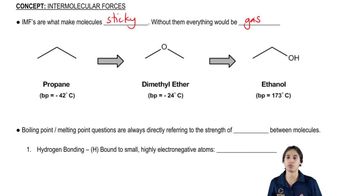
How IMFs are related to melting and boiling points.

Intermolecular Forces

Intermolecular forces, particularly London dispersion forces, play a crucial role in determining boiling points. Larger hydrocarbons have more surface area, leading to stronger dispersion forces, which require more energy (heat) to overcome, resulting in higher boiling points for larger molecules.
Recommended video:
Guided course
03:01
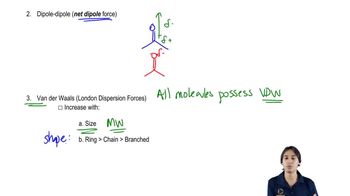
How Van der Waals forces work.

Structural Isomerism

Structural isomerism refers to compounds with the same molecular formula but different structural arrangements. In the context of boiling points, isomers can exhibit different boiling points due to variations in their shapes and the resulting differences in intermolecular interactions, although this is less relevant when comparing straight-chain alkanes like eicosane and pentadecane.
Recommended video:
Guided course
06:47
Monosaccharides - D and L Isomerism