Ch. 3 - Alkanes and Cycloalkanes: Properties and Conformational Analysis
Mullins - Organic Chemistry: A Learner Centered Approach 1st Edition
Mullins1st EditionOrganic Chemistry: A Learner Centered ApproachISBN: 9780137566471Not the one you use?Change textbook
Chapter 2, Problem 7

Draw the molecular orbital picture for propane. Your picture should clearly show the shape and hybridization of the carbons. Label all σ bonds.
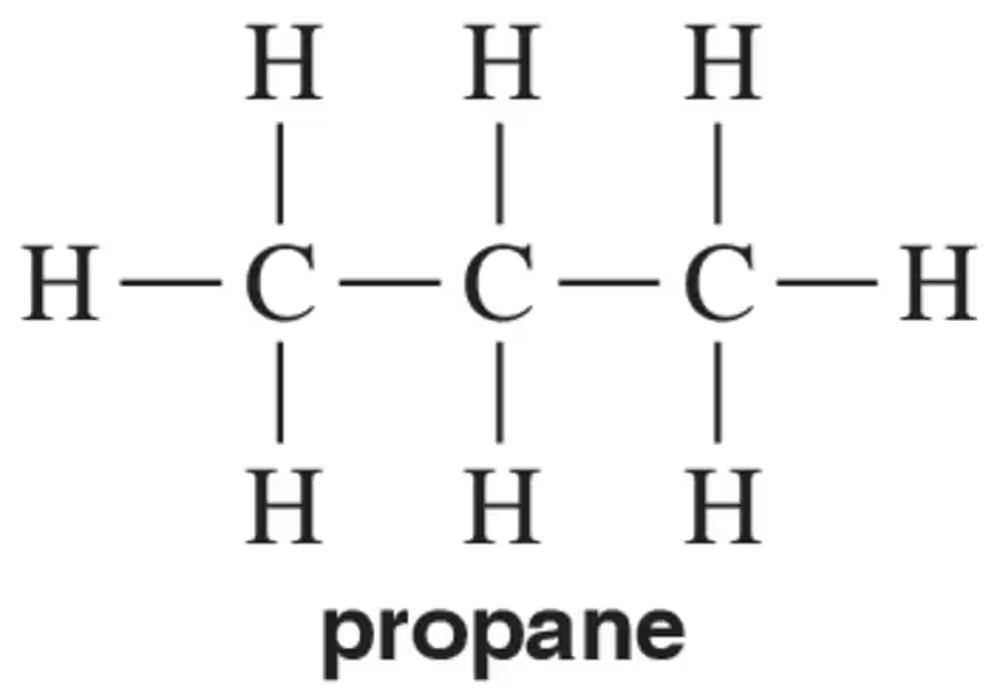
Molecular structure of propane, showing carbon atoms, hydrogen atoms, and labeled sigma bonds.

Verified step by step guidance
1
Step 1: Begin by identifying the molecular structure of propane (C3H8). Propane consists of three carbon atoms bonded in a chain, with each carbon atom bonded to sufficient hydrogen atoms to satisfy the octet rule.
Step 2: Determine the hybridization of each carbon atom. In propane, all carbon atoms are sp³ hybridized because they form four sigma (σ) bonds each (single bonds only). This hybridization results in tetrahedral geometry around each carbon atom.
Step 3: Draw the molecular orbital picture for propane. Represent each carbon atom with its sp³ hybrid orbitals arranged in a tetrahedral geometry. Show the overlap of sp³ orbitals between adjacent carbon atoms to form C-C σ bonds, and the overlap of sp³ orbitals with hydrogen's 1s orbitals to form C-H σ bonds.
Step 4: Label all σ bonds in the diagram. There are two C-C σ bonds formed by the overlap of sp³ orbitals from adjacent carbon atoms, and eight C-H σ bonds formed by the overlap of sp³ orbitals from carbon atoms with 1s orbitals from hydrogen atoms.
Step 5: Ensure the diagram clearly shows the spatial arrangement of the orbitals and bonds. Highlight the tetrahedral geometry around each carbon atom and the linear arrangement of the three carbon atoms in the propane molecule.

Verified video answer for a similar problem:

This video solution was recommended by our tutors as helpful for the problem above.
Video duration:
8m
Was this helpful?

Key Concepts

Here are the essential concepts you must grasp in order to answer the question correctly.

Molecular Orbitals

Molecular orbitals (MOs) are formed by the combination of atomic orbitals when atoms bond together. In propane, the MOs help visualize how electrons are distributed among the carbon and hydrogen atoms. Understanding MOs is crucial for predicting the shape and stability of the molecule, as well as the types of bonds formed.
Recommended video:
Guided course
08:41
Review of Molecular Orbitals

Hybridization

Hybridization is the process by which atomic orbitals mix to form new, equivalent hybrid orbitals that can accommodate bonding. In propane, the carbon atoms undergo sp³ hybridization, resulting in four equivalent sp³ hybrid orbitals that form σ bonds with hydrogen and other carbon atoms, leading to a tetrahedral geometry.
Recommended video:
Guided course
10:43
Using bond sites to predict hybridization

Sigma (σ) Bonds

Sigma bonds are the strongest type of covalent bond formed by the head-on overlap of atomic orbitals. In propane, each carbon forms σ bonds with three hydrogen atoms and one other carbon atom. These bonds are essential for the molecule's structure and stability, and they can be identified in the molecular orbital diagram.
Recommended video:
Guided course
01:05
Sigma bonds and pi bonds