Ch. 3 - Alkanes and Cycloalkanes: Properties and Conformational Analysis
Mullins - Organic Chemistry: A Learner Centered Approach 1st Edition
Mullins1st EditionOrganic Chemistry: A Learner Centered ApproachISBN: 9780137566471Not the one you use?Change textbook
Chapter 2, Problem 59e

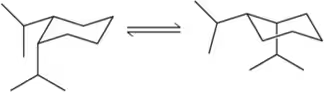
For each pair of conformations shown, choose which is most stable. If both are equally stable, then write 'no difference.' [If both conformations have the same number of axial substituents, choose the one with the smallest axial substituents.]
(e) Two molecular conformations of a cycloalkane with arrows indicating equilibrium; assess stability based on axial substituents.

Verified step by step guidance
1
Step 1: Understand the concept of chair conformations in cyclohexane. Cyclohexane can adopt two chair conformations, and substituents on the ring can occupy either axial (vertical) or equatorial (horizontal) positions. Axial positions are less stable due to steric hindrance and 1,3-diaxial interactions.
Step 2: Analyze the substituents in each conformation. Identify the positions (axial or equatorial) of all substituents in both conformations. Larger substituents in axial positions cause more steric hindrance compared to smaller substituents.
Step 3: Compare the number of axial substituents in both conformations. The conformation with fewer axial substituents is generally more stable due to reduced steric hindrance.
Step 4: If both conformations have the same number of axial substituents, compare the size of the axial substituents. The conformation with smaller axial substituents will be more stable because smaller groups cause less steric hindrance.
Step 5: Based on the analysis, determine which conformation is more stable or conclude 'no difference' if both conformations are equally stable.

Verified video answer for a similar problem:

This video solution was recommended by our tutors as helpful for the problem above.
Video duration:
2m
Was this helpful?

Key Concepts

Here are the essential concepts you must grasp in order to answer the question correctly.

Conformational Analysis

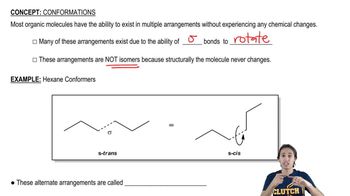
Conformational analysis involves studying the different spatial arrangements of a molecule that can be interconverted by rotation around single bonds. In organic chemistry, this is crucial for understanding the stability of various conformations, as certain arrangements can lead to steric hindrance or torsional strain, affecting the overall energy and stability of the molecule.
Recommended video:
Guided course
03:29
Understanding what a conformer is.

Axial and Equatorial Positions

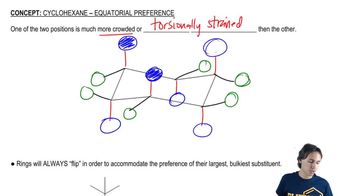
In cyclohexane and similar structures, substituents can occupy axial (pointing up or down) or equatorial (pointing outward) positions. Axial substituents can lead to 1,3-diaxial interactions, which increase steric strain and reduce stability. Therefore, when comparing conformations, the preference for equatorial positions is a key factor in determining which conformation is more stable.
Recommended video:
Guided course
04:02
Equatorial Preference

Steric Hindrance

Steric hindrance refers to the repulsion between atoms that occurs when they are brought too close together, often due to the size of substituents. In conformational analysis, larger substituents are more likely to cause steric hindrance when in axial positions, making those conformations less stable. Understanding this concept is essential for predicting the most stable conformation based on the size and position of substituents.
Recommended video:
Guided course
02:53
Understanding steric effects.
Related Practice
Textbook Question

What is the mistake that was made in drawing each of the flipped chairs on the right from the chair on the left? [In these, assume that the angle through which you view the chair conformations doesn't change.]

(a)

1123
views

Textbook Question

For each chair on the left, place the substituents on the flipped chair. [Recall that the axial/equatorial designation changes from one chair to the next, but the carbon to which the substituent is attached does not.]

(f)

953
views
Textbook Question

For each pair of conformations shown, choose which is most stable. If both are equally stable, then write 'no difference.' [If both conformations have the same number of axial substituents, choose the one with the smallest axial substituents.]

(g)

1122
views
Textbook Question

For each structure shown, draw the two chair conformations and choose which is most stable. Be sure that your second chair is the flipped version of the first. [Make sure that wedged substituents are up in the chair, regardless of whether up is equatorial or axial.]

(g)

1247
views
Textbook Question

For each chair on the left, place the substituents on the flipped chair. [Recall that the axial/equatorial designation changes from one chair to the next, but the carbon to which the substituent is attached does not.]

(e)

741
views
Textbook Question

For each structure shown, draw the two chair conformations and choose which is most stable. Be sure that your second chair is the flipped version of the first. [Make sure that wedged substituents are up in the chair, regardless of whether up is equatorial or axial.]

(e)

1557
views