Ch. 3 - Alkanes and Cycloalkanes: Properties and Conformational Analysis
Mullins - Organic Chemistry: A Learner Centered Approach 1st Edition
Mullins1st EditionOrganic Chemistry: A Learner Centered ApproachISBN: 9780137566471Not the one you use?Change textbook
Chapter 2, Problem 15k

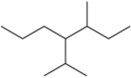
Name the following alkanes using the IUPAC system of nomenclature. [Each molecule exemplifies one of the nomenclature rules in Tables 3.7 and 3.8.]
(k) rule 6
Structural formula of an alkane with a branched chain, illustrating IUPAC naming conventions.

Verified step by step guidance
1
Identify the longest continuous chain of carbon atoms in the molecule. This chain will serve as the parent chain, and its length determines the base name of the alkane (e.g., methane, ethane, propane, etc.).
Number the carbon atoms in the parent chain starting from the end nearest to the first substituent group. This ensures the substituents receive the lowest possible numbers.
Identify and name all substituent groups attached to the parent chain. Substituents are named based on the number of carbon atoms they contain (e.g., methyl, ethyl, propyl, etc.).
Combine the names of the substituents with the parent chain name. Use prefixes to indicate the number of identical substituents (e.g., di-, tri-, tetra-) and place the substituent names in alphabetical order. Include the position numbers of the substituents before their names.
Ensure the name follows IUPAC Rule 6, which states that if two chains of equal length are present, choose the chain with the greater number of substituents as the parent chain. Double-check the numbering and naming for accuracy.

Verified video answer for a similar problem:

This video solution was recommended by our tutors as helpful for the problem above.
Video duration:
3m
Was this helpful?

Key Concepts

Here are the essential concepts you must grasp in order to answer the question correctly.

IUPAC Nomenclature

The International Union of Pure and Applied Chemistry (IUPAC) nomenclature provides a systematic method for naming organic compounds. It establishes rules to ensure that each compound has a unique and descriptive name, which reflects its structure. Understanding these rules is essential for accurately identifying and communicating about organic molecules.
Recommended video:
Guided course
03:43
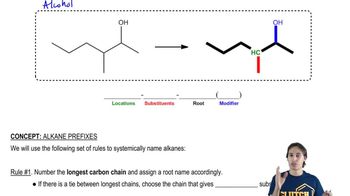
The different parts of an IUPAC name

Alkane Structure

Alkanes are saturated hydrocarbons characterized by single bonds between carbon atoms and the general formula CnH2n+2. Their structure can be linear or branched, and recognizing the arrangement of carbon atoms is crucial for proper nomenclature. The number of carbon atoms and their connectivity directly influence the name assigned to the alkane.
Recommended video:
Guided course
02:47
Functionalizing Alkanes

Nomenclature Rules

The IUPAC nomenclature rules include guidelines for identifying the longest carbon chain, naming substituents, and numbering the carbon atoms to give the lowest possible numbers to substituents. Rule 6 specifically addresses the naming of branched alkanes, emphasizing the importance of identifying the main chain and correctly labeling side groups. Mastery of these rules is vital for accurately naming organic compounds.
Recommended video:
4:02
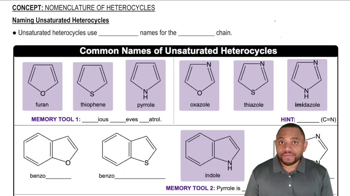
Nomenclature of Heterocycles Concept 2