Textbook Question
When we begin studying reactive intermediates, the designation of substitution will be especially important. Label the following carbocations as 1° , 2°, 3°, or 4° or based on the carbon bearing the positive charge.
(b)
929
views

 Mullins 1st EditionCh. 3 - Alkanes and Cycloalkanes: Properties and Conformational AnalysisProblem 15n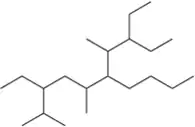
 Verified step by step guidance
 03:43
03:43
 02:47
02:47 02:24
02:24When we begin studying reactive intermediates, the designation of substitution will be especially important. Label the following carbocations as 1° , 2°, 3°, or 4° or based on the carbon bearing the positive charge.
(b)
Name the following alkanes using the IUPAC system of nomenclature. [Each molecule exemplifies one of the nomenclature rules in Tables 3.7 and 3.8.]
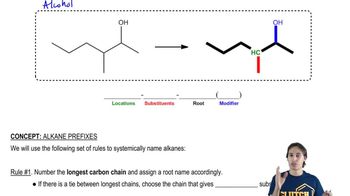
(k) rule 6
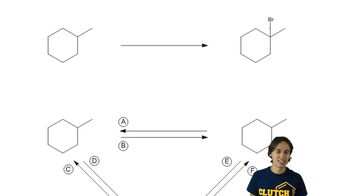
When we begin studying functional groups, the designation of substitution will be especially important. Label the following bromoalkanes as 1° , 2°, 3°, or 4° based on the carbon to which the bromine is attached.
(b)
When we begin studying reactive intermediates, the designation of substitution will be especially important. Label the following carbocations as 1° , 2°, 3°, or 4° or based on the carbon bearing the positive charge.
(c)
Name the following alkanes using the IUPAC system of nomenclature. [Each molecule exemplifies one of the nomenclature rules in Tables 3.7 and 3.8.]
(j) rule 5
There are nine alkane constitutional isomers with the molecular formula C7H16. Draw them.