Ch. 4 - Acids and Bases: Electron Flow
Mullins - Organic Chemistry: A Learner Centered Approach 1st Edition
Mullins1st EditionOrganic Chemistry: A Learner Centered ApproachISBN: 9780137566471Not the one you use?Change textbook
Chapter 3, Problem 15b

Based on the one species that is identified for you, label the remaining molecules as acid, base, conjugate acid, or conjugate base.
(b) Chemical reaction diagram showing an acid-base reaction with labeled species as acid, base, conjugate acid, and conjugate base.

Verified step by step guidance
1
Step 1: Identify the species already labeled in the reaction. In this case, H2PO4⁻ is labeled as a 'Base'. This means it accepted a proton (H⁺) during the reaction.
Step 2: Analyze the reactants. H3PO4 is a proton donor, as it loses a proton to form H2PO4⁻. Therefore, H3PO4 is the 'Acid' in this reaction.
Step 3: Examine the organic molecule on the left side of the reaction. It reacts with H3PO4 and gains a proton, forming the positively charged species on the right side. This indicates that the organic molecule is acting as a 'Base' because it accepts a proton.
Step 4: Look at the positively charged organic molecule formed on the right side of the reaction. Since it is the protonated form of the original organic molecule, it is the 'Conjugate Acid' of the base.
Step 5: Summarize the labels: H3PO4 is the Acid, the organic molecule on the left is the Base, the positively charged organic molecule on the right is the Conjugate Acid, and H2PO4⁻ is the Conjugate Base.

Verified video answer for a similar problem:

This video solution was recommended by our tutors as helpful for the problem above.
Video duration:
2m
Was this helpful?

Key Concepts

Here are the essential concepts you must grasp in order to answer the question correctly.

Acids and Bases

Acids are substances that can donate a proton (H+) in a chemical reaction, while bases are substances that can accept a proton. This concept is fundamental in understanding acid-base reactions, where the transfer of protons between species determines their classification as acids or bases.
Recommended video:
Guided course
02:49
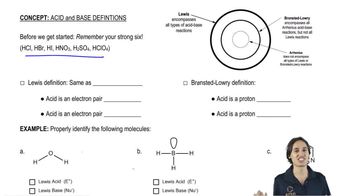
The Lewis definition of acids and bases.

Conjugate Acid-Base Pairs

A conjugate acid is formed when a base gains a proton, while a conjugate base is formed when an acid loses a proton. This relationship is crucial for identifying the species involved in acid-base reactions, as it helps to track the changes in protonation states of the molecules.
Recommended video:
2:56
Base Pairing Concept 1

Chemical Equilibrium

Chemical equilibrium refers to the state in which the rates of the forward and reverse reactions are equal, resulting in constant concentrations of reactants and products. Understanding this concept is essential for predicting the direction of acid-base reactions and the relative strengths of acids and bases in a given reaction.
Recommended video:
3:11
Chemical Reactions of Phosphate Anhydrides Concept 1