Ch. 4 - Acids and Bases: Electron Flow
Mullins - Organic Chemistry: A Learner Centered Approach 1st Edition
Mullins1st EditionOrganic Chemistry: A Learner Centered ApproachISBN: 9780137566471Not the one you use?Change textbook
Chapter 3, Problem 16a

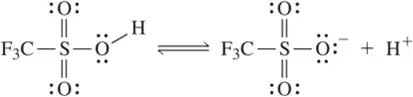
Provide an arrow-pushing mechanism for the following hypothetical acid half-reactions. [These are only intended to help you learn about arrow pushing in acid–base reactions.]
(a) Arrow-pushing mechanism illustrating acid half-reactions with structures and electron movement.

Verified step by step guidance
1
Identify the reactants and products in the given acid half-reaction. Determine which species is acting as the acid (proton donor) and which is the base (proton acceptor).
Draw the Lewis structures of all reactants to clearly visualize lone pairs and bonding electrons. This will help in understanding the electron flow.
Use curved arrows to represent the movement of electrons. Start the arrow at the electron source (e.g., a lone pair or a bond) and point it toward the electron sink (e.g., a proton or an atom that will accept the electrons).
Ensure that the proton transfer is shown correctly. For example, if a base is deprotonating the acid, draw an arrow from the lone pair on the base to the hydrogen atom of the acid, and another arrow from the bond between the hydrogen and its original atom to that atom (indicating bond breaking).
Verify that the resulting products are consistent with the acid-base reaction. Check that charges are balanced and that the electron flow adheres to the rules of organic chemistry (e.g., octet rule, formal charges).

Verified video answer for a similar problem:

This video solution was recommended by our tutors as helpful for the problem above.
Video duration:
1m
Was this helpful?

Key Concepts

Here are the essential concepts you must grasp in order to answer the question correctly.

Acid-Base Theory

Acid-base theory explains the behavior of acids and bases in chemical reactions. According to the Brønsted-Lowry theory, acids are proton donors while bases are proton acceptors. Understanding this concept is crucial for predicting the direction of proton transfer in reactions, which is fundamental for arrow-pushing mechanisms.
Recommended video:
Guided course
02:49
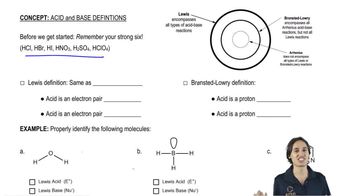
The Lewis definition of acids and bases.

Arrow-Pushing Mechanism

Arrow-pushing mechanisms are a visual representation of the movement of electrons during chemical reactions. In these diagrams, arrows indicate the flow of electron pairs, showing how bonds are formed and broken. Mastering this technique is essential for illustrating the stepwise process of acid-base reactions and understanding the underlying electron dynamics.
Recommended video:
Guided course
04:32
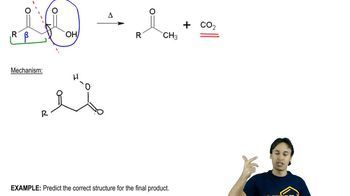
General Mechanism

Resonance Structures

Resonance structures are different ways of drawing the same molecule that illustrate the delocalization of electrons. In acid-base reactions, resonance can stabilize intermediates and influence the acidity or basicity of a compound. Recognizing resonance is important for predicting reaction outcomes and understanding the stability of reaction intermediates.
Recommended video:
Guided course
03:04
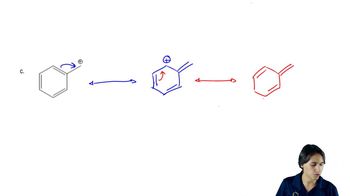
Drawing Resonance Structures