Rank the following alcohols in order of descending pKa value. Explain your ranking.
Ch. 4 - Acids and Bases: Electron Flow

Mullins1st EditionOrganic Chemistry: A Learner Centered ApproachISBN: 9780137566471Not the one you use?Change textbook
Chapter 3, Problem 51a
Identify the most stable conjugate base in each pair. Tell which structural features you analyzed and why you weighted them as you did in picking one answer.
(a) 
Verified step by step guidance1
Analyze the electronegativity of the atoms bearing the negative charge. Oxygen (O) is more electronegative than sulfur (S), meaning it can better stabilize a negative charge.
Consider the inductive effect of the trifluoromethyl group (CF₃) attached to the oxygen atom. The CF₃ group is highly electronegative and withdraws electron density through the sigma bond, further stabilizing the negative charge on the oxygen.
Compare the size of the atoms. Sulfur is larger than oxygen, which allows the negative charge to be spread over a larger volume, providing some stabilization. However, this effect is less significant compared to the electronegativity and inductive effects.
Evaluate the overall resonance and delocalization possibilities. In this case, neither structure has resonance stabilization, so this factor does not contribute to the stability comparison.
Weigh the combined effects of electronegativity and inductive stabilization (stronger in the CF₃O⁻ structure) against the size-based stabilization of sulfur. The CF₃O⁻ conjugate base is more stable due to the dominance of electronegativity and inductive effects.

Verified video answer for a similar problem:
This video solution was recommended by our tutors as helpful for the problem above.
Was this helpful?
Key Concepts
Here are the essential concepts you must grasp in order to answer the question correctly.
Conjugate Bases
A conjugate base is the species that remains after an acid donates a proton (H+). The stability of a conjugate base is crucial in determining the strength of its corresponding acid; stronger acids have more stable conjugate bases. Factors influencing stability include electronegativity, resonance, and the size of the atom bearing the negative charge.
Recommended video:
Guided course
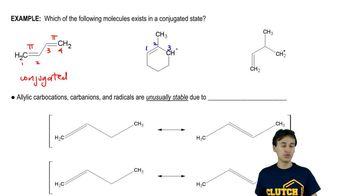
Conjugated states
Resonance Stabilization
Resonance stabilization occurs when a molecule can be represented by multiple valid Lewis structures, allowing the negative charge to be delocalized over several atoms. This delocalization reduces electron density on any single atom, enhancing stability. In evaluating conjugate bases, resonance is a key factor, as more resonance structures typically lead to greater stability.
Recommended video:
Guided course
The radical stability trend.
Electronegativity and Charge Distribution
Electronegativity refers to the ability of an atom to attract electrons in a bond. In the context of conjugate bases, a more electronegative atom stabilizing a negative charge will lead to a more stable conjugate base. When analyzing pairs of conjugate bases, the distribution of charge relative to electronegativity helps determine which base is more stable, as negative charges are better accommodated by more electronegative atoms.
Recommended video:
Guided course
Electronegativity
Related Practice
Textbook Question
1107
views
Textbook Question
Identify the most stable conjugate base in each pair. Tell which structural features you analyzed and why you weighted them as you did in picking one answer.
(f)
925
views
Textbook Question
Identify the most stable conjugate base in each pair. Tell which structural features you analyzed and why you weighted them as you did in picking one answer.
(e)
1625
views
Textbook Question
If reacted with a strong base, which of the labeled protons would you expect to be removed first?
909
views
Textbook Question
Rank the following amines in order of their basicity (strongest base = 1 ; weakest base = 6).
1319
views
Textbook Question
Identify the most stable conjugate base in each pair. Tell which structural features you analyzed and why you weighted them as you did in picking one answer.
(c)
1160
views