Ch. 4 - Acids and Bases: Electron Flow
Mullins - Organic Chemistry: A Learner Centered Approach 1st Edition
Mullins1st EditionOrganic Chemistry: A Learner Centered ApproachISBN: 9780137566471Not the one you use?Change textbook
Chapter 3, Problem 50

If reacted with a strong base, which of the labeled protons would you expect to be removed first?
Chemical structure showing protons labeled Ha, Hb, and Hc, with an arrow indicating reaction with a strong base.

Verified step by step guidance
1
Step 1: Identify the labeled protons (Ha, Hb, Hc) in the molecule and their chemical environments. Ha is attached to a sp2-hybridized carbon in the cyclohexene ring, Hb is attached to a sp-hybridized carbon in the alkyne group, and Hc is attached to a sp3-hybridized carbon in the cyclohexane ring.
Step 2: Recall that the acidity of a proton is influenced by the hybridization of the carbon it is attached to. Protons attached to sp-hybridized carbons are generally more acidic than those attached to sp2 or sp3 carbons due to the higher electronegativity of sp-hybridized carbons.
Step 3: Consider the role of the strong base (:NH2−). A strong base will preferentially remove the most acidic proton, which corresponds to the proton with the lowest pKa value.
Step 4: Compare the acidity of the labeled protons. Hb, attached to the sp-hybridized carbon, is the most acidic due to the high s-character of the sp orbital. Ha, attached to the sp2-hybridized carbon, is less acidic, and Hc, attached to the sp3-hybridized carbon, is the least acidic.
Step 5: Conclude that the strong base (:NH2−) will first remove Hb, the proton attached to the sp-hybridized carbon in the alkyne group, because it is the most acidic.

Verified video answer for a similar problem:

This video solution was recommended by our tutors as helpful for the problem above.
Was this helpful?

Key Concepts

Here are the essential concepts you must grasp in order to answer the question correctly.

Acidity and Basicity

Acidity refers to the tendency of a compound to donate protons (H+ ions), while basicity is the ability to accept protons. In organic chemistry, the strength of an acid is often determined by the stability of its conjugate base. Stronger acids have more stable conjugate bases, making them more likely to lose protons when reacted with a strong base.
Recommended video:
Guided course
06:21
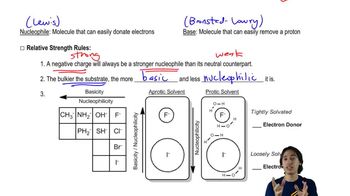
Understanding the difference between basicity and nucleophilicity.

Proton Removal and pKa

The pKa value is a quantitative measure of the acidity of a proton in a molecule. Lower pKa values indicate stronger acids, meaning the corresponding protons are more easily removed. When considering which proton will be removed first by a strong base, one should look for the proton with the lowest pKa, as it is the most acidic and thus the most reactive towards the base.
Recommended video:
Guided course
07:45
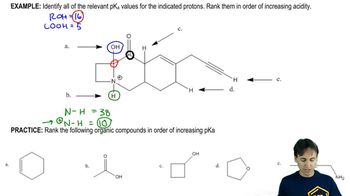
Identifying pKa values

Resonance Stabilization

Resonance stabilization occurs when a molecule can be represented by multiple valid Lewis structures, allowing for the delocalization of electrons. This delocalization can stabilize a conjugate base formed after proton removal. Protons attached to atoms that can participate in resonance are typically more acidic, as the resulting negative charge can be spread over multiple atoms, enhancing stability.
Recommended video:
Guided course
03:43
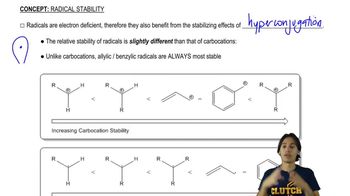
The radical stability trend.