Ch. 4 - Acids and Bases: Electron Flow
Mullins - Organic Chemistry: A Learner Centered Approach 1st Edition
Mullins1st EditionOrganic Chemistry: A Learner Centered ApproachISBN: 9780137566471Not the one you use?Change textbook
Chapter 3, Problem 67

Suggest a scheme by which N-methylmorpholine, salicylic acid, and naphthalene can be separated.

Verified step by step guidance
1
Step 1: Analyze the chemical properties of the three compounds. N-methylmorpholine is a basic amine due to the nitrogen atom, salicylic acid is an acidic compound due to the carboxylic acid group, and naphthalene is a neutral aromatic hydrocarbon.
Step 2: Begin separation by exploiting the acid-base properties. Add a dilute acid (e.g., HCl) to the mixture. This will protonate N-methylmorpholine, converting it into a water-soluble salt, while salicylic acid and naphthalene remain unaffected.
Step 3: Extract the aqueous layer containing the protonated N-methylmorpholine. The organic layer will contain salicylic acid and naphthalene. Neutralize the aqueous layer with a base (e.g., NaOH) to regenerate N-methylmorpholine, which can then be extracted back into an organic solvent.
Step 4: Separate salicylic acid and naphthalene by exploiting their solubility differences. Add a dilute base (e.g., NaOH) to the organic layer. This will deprotonate salicylic acid, converting it into a water-soluble salt, while naphthalene remains in the organic layer.
Step 5: Extract the aqueous layer containing the salicylic acid salt. Neutralize it with a dilute acid (e.g., HCl) to regenerate salicylic acid, which can then be extracted back into an organic solvent. Naphthalene remains in the organic layer and can be isolated by evaporation of the solvent.

Verified video answer for a similar problem:

This video solution was recommended by our tutors as helpful for the problem above.
Video duration:
11m
Was this helpful?

Key Concepts

Here are the essential concepts you must grasp in order to answer the question correctly.

Solubility Principles

Understanding solubility is crucial for separating compounds based on their physical properties. N-methylmorpholine is a polar amine, salicylic acid is a weak acid, and naphthalene is a nonpolar hydrocarbon. By exploiting differences in solubility in various solvents, one can selectively dissolve and separate these compounds.
Recommended video:
Guided course
02:01
Introducing common solvents and other molecules in organic chemistry.

Acid-Base Chemistry

Acid-base chemistry plays a significant role in the separation of salicylic acid from the other compounds. Salicylic acid can be deprotonated to form its anionic form in a basic solution, making it soluble in water, while N-methylmorpholine and naphthalene remain less soluble. This property can be utilized to separate salicylic acid from the mixture.
Recommended video:
Guided course
02:49
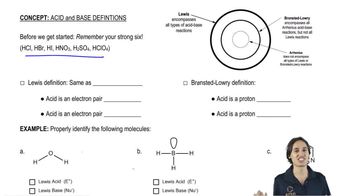
The Lewis definition of acids and bases.

Extraction Techniques

Extraction techniques, such as liquid-liquid extraction, are essential for separating compounds based on their solubility in different solvents. By choosing appropriate solvents, one can selectively extract N-methylmorpholine, salicylic acid, and naphthalene from the mixture. This method allows for the isolation of each compound based on their unique chemical properties.
Recommended video:
Guided course
05:41
Reason for Analytical Methods