Ch. 4 - Acids and Bases: Electron Flow
Mullins - Organic Chemistry: A Learner Centered Approach 1st Edition
Mullins1st EditionOrganic Chemistry: A Learner Centered ApproachISBN: 9780137566471Not the one you use?Change textbook
Chapter 3, Problem 75

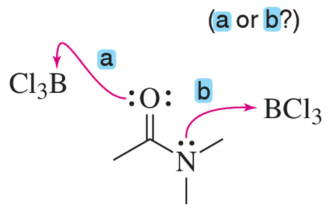
BCl3 has an empty p orbital, so it is a strong Lewis acid. Would you expect an amide to react with BCl3 at nitrogen or oxygen?

Verified step by step guidance
1
Step 1: Understand the nature of BCl3 as a Lewis acid. BCl3 has an empty p orbital, making it electron-deficient and capable of accepting electron pairs from Lewis bases.
Step 2: Analyze the amide structure. An amide contains both a nitrogen atom with a lone pair and an oxygen atom with lone pairs. Both atoms can act as Lewis bases and donate electron pairs.
Step 3: Compare the electronegativity of oxygen and nitrogen. Oxygen is more electronegative than nitrogen, meaning its lone pairs are held more tightly and are less available for donation compared to nitrogen's lone pairs.
Step 4: Consider steric factors. The nitrogen atom in the amide is less sterically hindered compared to the oxygen atom, making it more accessible for interaction with BCl3.
Step 5: Conclude that the nitrogen atom is more likely to react with BCl3 due to its less tightly held lone pair and greater accessibility compared to the oxygen atom.

Verified video answer for a similar problem:

This video solution was recommended by our tutors as helpful for the problem above.
Video duration:
3m
Was this helpful?

Key Concepts

Here are the essential concepts you must grasp in order to answer the question correctly.

Lewis Acids and Bases

Lewis acids are substances that can accept an electron pair, while Lewis bases are those that can donate an electron pair. In this context, BCl₃ acts as a Lewis acid due to its empty p orbital, allowing it to interact with electron-rich species. Understanding this interaction is crucial for predicting the reactivity of amides with BCl₃.
Recommended video:
Guided course
02:49
The Lewis definition of acids and bases.

Amides Structure and Reactivity

Amides are organic compounds characterized by a carbonyl group (C=O) bonded to a nitrogen atom (N). The nitrogen in amides is typically a Lewis base due to its lone pair of electrons, while the oxygen can also participate in reactions. Recognizing the functional groups and their electron-donating or accepting abilities is essential for determining the site of reaction with Lewis acids like BCl₃.
Recommended video:
Guided course
01:33
Amide Nomenclature

Nucleophilicity

Nucleophilicity refers to the ability of a species to donate an electron pair to an electrophile. In the case of amides, the nitrogen atom is generally more nucleophilic than the oxygen atom due to its less electronegative nature and the presence of a lone pair. This concept is vital for predicting whether the reaction with BCl₃ will occur at the nitrogen or oxygen site.
Recommended video:
Guided course
08:27
Nucleophilic Addition