Textbook Question
The radical fluorination of 2-methyl propane resulted in a 14:86 ratio of products.
(a) On the basis of this ratio, calculate the relative reactivity of 1° and 3° C―H bonds in the radical fluorination.
1167
views

 Mullins 1st EditionCh. 5 - Chemical Reaction Analysis: Thermodynamics and KineticsProblem 42
 Verified step by step guidance
 00:54
00:54
 3:15
3:15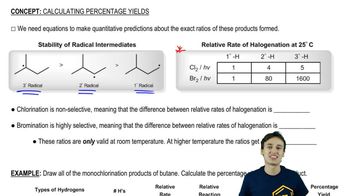 04:32
04:32The radical fluorination of 2-methyl propane resulted in a 14:86 ratio of products.
(a) On the basis of this ratio, calculate the relative reactivity of 1° and 3° C―H bonds in the radical fluorination.
The following are all substitution reactions, two of which we study in later chapters. With no knowledge of mechanism, what would you expect the ratio of products to be for each reaction, based on a random statistical distribution?
(b) Replacing a hydrogen (H) with bromine (Br):
Through the course of this chapter, we have discussed only alkane chlorination and bromination, yet there are two other halogens we have not discussed.
(b) Is radical iodination a favorable reaction? Do you expect it to be selective? Show your calculations.
The following are all substitution reactions, two of which we study in later chapters. With no knowledge of mechanism, what would you expect the ratio of products to be for each reaction, based on a random statistical distribution?
(a) Replacing a hydrogen (H) with deuterium (D):
The radical fluorination of 2-methyl propane resulted in a 14:86 ratio of products.
(b) From the relative reactivity, calculate the difference in energy between the transition states of the first propagation steps leading to a 1° and 3° radical.
The following are all substitution reactions, two of which we study in later chapters. With no knowledge of mechanism, what would you expect the ratio of products to be for each reaction, based on a random statistical distribution?
(a) Replacing a hydrogen (H) with chlorine (Cl):