Ch. 5 - Chemical Reaction Analysis: Thermodynamics and Kinetics
Mullins - Organic Chemistry: A Learner Centered Approach 1st Edition
Mullins1st EditionOrganic Chemistry: A Learner Centered ApproachISBN: 9780137566471Not the one you use?Change textbook
Chapter 4, Problem 43b

Through the course of this chapter, we have discussed only alkane chlorination and bromination, yet there are two other halogens we have not discussed.
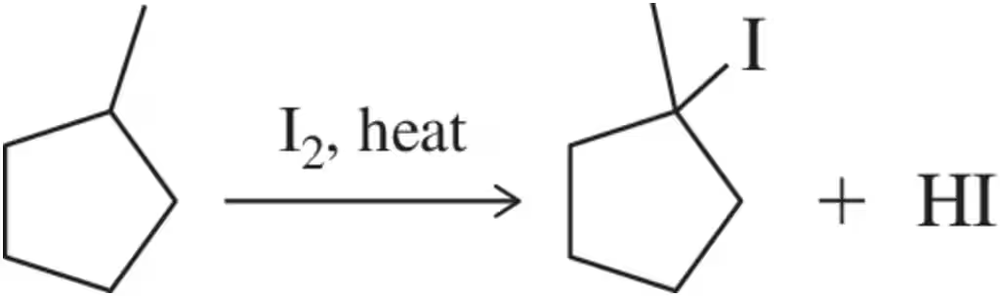
(b) Is radical iodination a favorable reaction? Do you expect it to be selective? Show your calculations.
Reaction of cyclohexene with iodine and heat, producing iodocyclohexane and hydrogen iodide.

Verified step by step guidance
1
Step 1: Begin by understanding the concept of radical halogenation. Radical halogenation involves the substitution of a hydrogen atom in an alkane with a halogen atom through a radical mechanism. The favorability of the reaction depends on the bond dissociation energies (BDEs) of the involved bonds.
Step 2: Analyze the bond dissociation energies (BDEs) for the relevant bonds. For radical iodination, the key bonds to consider are the C-H bond in the alkane and the I-I bond in molecular iodine. Compare these values to determine if the reaction is thermodynamically favorable. Use the equation ΔH = BDE(C-H) - BDE(I-I) to calculate the enthalpy change.
Step 3: Consider the activation energy and reaction kinetics. Radical iodination typically has a high activation energy due to the weak I-I bond and the low reactivity of iodine radicals. This makes the reaction slow and less favorable compared to chlorination or bromination.
Step 4: Evaluate the selectivity of the reaction. Radical halogenation reactions are selective based on the stability of the intermediate radicals formed. Iodine radicals are less reactive, which could lead to lower selectivity compared to bromination, but the reaction is generally not favorable enough to proceed efficiently.
Step 5: Summarize the findings. Radical iodination is not a favorable reaction due to its unfavorable thermodynamics (positive ΔH) and slow kinetics. Additionally, the selectivity is not expected to be significant because the reaction does not proceed efficiently under typical conditions.

Verified video answer for a similar problem:

This video solution was recommended by our tutors as helpful for the problem above.
Video duration:
14m
Was this helpful?

Key Concepts

Here are the essential concepts you must grasp in order to answer the question correctly.

Radical Halogenation

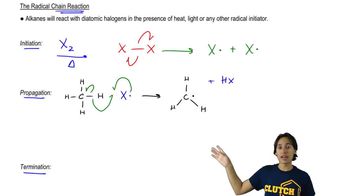
Radical halogenation is a reaction mechanism where alkanes react with halogens (like Cl2 or Br2) to form alkyl halides through a radical chain process. This involves the generation of halogen radicals, which abstract hydrogen atoms from alkanes, leading to the formation of new carbon-halogen bonds. Understanding this mechanism is crucial for analyzing the reactivity and selectivity of different halogens in substitution reactions.
Recommended video:
Guided course
12:11
Radical Chain Reaction Mechanism.

Selectivity in Halogenation

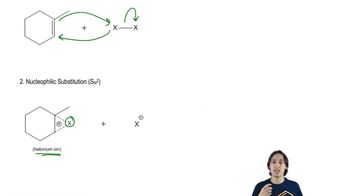
Selectivity in halogenation refers to the preference of a halogen to react with certain hydrogen atoms over others in an alkane. Bromination is generally more selective than chlorination due to the stability of the bromine radical, which favors the formation of more stable products. In the case of iodination, the selectivity is lower, and understanding this concept helps predict the outcomes of radical iodination reactions.
Recommended video:
Guided course
03:45
Halogenation Mechanism

Thermodynamics and Kinetics of Iodination

The thermodynamics and kinetics of iodination involve evaluating the energy changes and reaction rates associated with the formation of iodine radicals. Iodine is less reactive than chlorine and bromine, making radical iodination less favorable and slower. Calculating the activation energy and comparing the bond dissociation energies of the halogens can provide insights into the feasibility and selectivity of radical iodination.
Recommended video:
Guided course
08:51
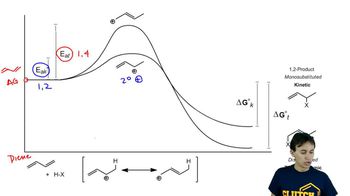
Kinetic vs. Thermodynamic Control
Related Practice