
Ch. 5 - Chemical Reaction Analysis: Thermodynamics and Kinetics
Mullins - Organic Chemistry: A Learner Centered Approach 1st Edition
Mullins1st EditionOrganic Chemistry: A Learner Centered ApproachISBN: 9780137566471Not the one you use?Change textbook
Chapter 4, Problem 65a

In Chapter 13, we discuss the ring-opening reactions of epoxides, such as the one shown here.

(a) Based on the bonds formed and the bonds broken, calculate ∆H°.

Verified step by step guidance
1
Step 1: Identify the bonds broken in the reaction. In the given reaction, the epoxide ring is opened. This involves breaking one C-O bond in the epoxide ring.
Step 2: Identify the bonds formed in the reaction. In the product, a new C-O bond is formed between the methanol (CH3OH) and one of the carbons from the epoxide ring. Additionally, a new O-H bond is formed on the other carbon of the epoxide ring.
Step 3: Use bond enthalpy values to calculate the energy change for the bonds broken. Look up the bond enthalpy for the C-O bond in the epoxide ring and sum the energy required to break it.
Step 4: Use bond enthalpy values to calculate the energy change for the bonds formed. Look up the bond enthalpy for the C-O bond (formed with CH3OH) and the O-H bond (formed on the other carbon). Sum the energy released when these bonds are formed.
Step 5: Calculate ∆H° for the reaction. Subtract the total energy of bonds formed from the total energy of bonds broken: ∆H° = (Energy of bonds broken) - (Energy of bonds formed).

Verified video answer for a similar problem:

This video solution was recommended by our tutors as helpful for the problem above.
Was this helpful?

Key Concepts

Here are the essential concepts you must grasp in order to answer the question correctly.

Epoxide Structure

Epoxides are three-membered cyclic ethers characterized by a highly strained ring structure. This strain makes them reactive intermediates in organic chemistry, allowing them to undergo ring-opening reactions. Understanding the geometry and bonding in epoxides is crucial for predicting their reactivity and the products formed during these reactions.
Recommended video:
Guided course
02:19
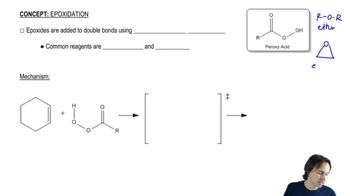
General properties of epoxidation.

Bond Enthalpy

Bond enthalpy refers to the amount of energy required to break a specific bond in a molecule. In the context of chemical reactions, calculating the change in enthalpy (∆H°) involves summing the bond enthalpies of bonds broken and formed. This concept is essential for determining the energy changes associated with the ring-opening of epoxides.
Recommended video:
Guided course
04:38
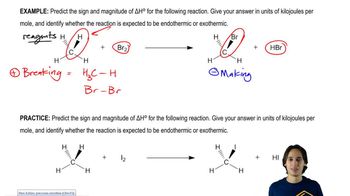
Calculating Enthalpies

Thermodynamics of Reactions

Thermodynamics in chemistry deals with the energy changes during chemical reactions. The change in enthalpy (∆H°) indicates whether a reaction is exothermic (releases energy) or endothermic (absorbs energy). Understanding these principles helps in predicting the feasibility and direction of the ring-opening reaction of epoxides based on the energy of the reactants and products.
Recommended video:
Guided course
08:51
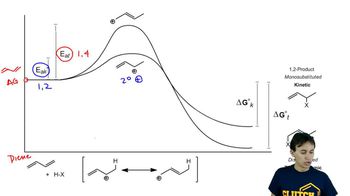
Kinetic vs. Thermodynamic Control
Related Practice
Textbook Question

The halogenation of an alkane when there is an alkene present in the molecule does not proceed with the regioselectivity you might expect. Using principles similar to those developed in this chapter, rationalize the formation of A as the only product. We study this reaction further in Chapter 8.

1028
views
Textbook Question

In light of your answers to parts (b) and (c), where both were shown to be quite favorable, imagine a scenario where either reaction is possible. Of the two, which would you expect to be faster? Which would you expect to be more favored? Explain each in the context of the important thermodynamic and/or kinetic parameters.

324
views
Textbook Question

When a student attempted a bromination to produce compound A, they generated compound B instead. Rationalize the formation of B using the arrow-pushing formalism.

1216
views
Textbook Question

Parts (a)–(d) of this assessment assist in the development of what will become a common theme in organic reactions and should be worked in order. [Think carefully about how each question relates to the others.]

(c) Without worrying about the mechanism of the reaction, estimate an equilibrium constant for the following carbonyl addition reaction based on the relative stability of the Lewis bases.

996
views
Textbook Question

In Chapter 13, we discuss the ring-opening reactions of epoxides, such as the one shown here.

(b) Predict the sign of ∆S°.

849
views
Textbook Question

Calculate Keq for the following acid–base reaction.

813
views