Ch. 5 - Chemical Reaction Analysis: Thermodynamics and Kinetics
Mullins - Organic Chemistry: A Learner Centered Approach 1st Edition
Mullins1st EditionOrganic Chemistry: A Learner Centered ApproachISBN: 9780137566471Not the one you use?Change textbook
Chapter 4, Problem 63d

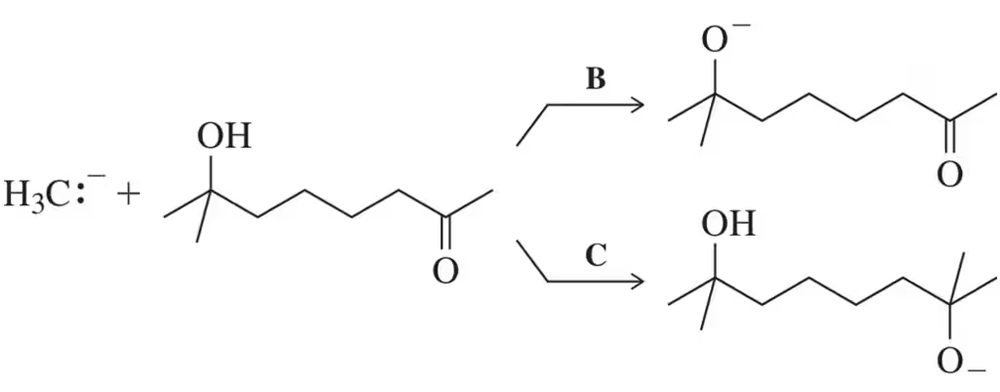
In light of your answers to parts (b) and (c), where both were shown to be quite favorable, imagine a scenario where either reaction is possible. Of the two, which would you expect to be faster? Which would you expect to be more favored? Explain each in the context of the important thermodynamic and/or kinetic parameters.
Chemical reaction diagram showing reactants and products with arrows indicating possible reaction pathways.

Verified step by step guidance
1
Step 1: Begin by reviewing the concepts of thermodynamics and kinetics in organic reactions. Thermodynamics refers to the favorability of a reaction based on energy changes (e.g., enthalpy and entropy), while kinetics refers to the speed of the reaction, which depends on the activation energy (Ea).
Step 2: Recall the answers to parts (b) and (c) of the problem. Identify which reaction was shown to be more thermodynamically favorable (lower Gibbs free energy, ΔG) and which had a lower activation energy (Ea), as these will guide your analysis.
Step 3: Analyze the reaction that is expected to be faster. A faster reaction is typically associated with a lower activation energy (Ea), as this means the energy barrier for the reaction to proceed is smaller. Compare the Ea values of the two reactions to determine which is kinetically favored.
Step 4: Analyze the reaction that is expected to be more favored overall. A more favored reaction is typically associated with a more negative ΔG, indicating that the products are more stable than the reactants. Compare the thermodynamic favorability of the two reactions based on their ΔG values.
Step 5: Synthesize your findings. Conclude which reaction is faster (kinetically favored) and which is more thermodynamically favored. Provide a clear explanation of how the kinetic and thermodynamic parameters influence each reaction, and discuss any potential trade-offs between speed and favorability in the context of the given scenario.

Verified video answer for a similar problem:

This video solution was recommended by our tutors as helpful for the problem above.
Video duration:
11m
Was this helpful?

Key Concepts

Here are the essential concepts you must grasp in order to answer the question correctly.

Thermodynamics

Thermodynamics in organic chemistry refers to the study of energy changes during chemical reactions. It helps determine the favorability of a reaction based on Gibbs free energy, where a negative change indicates a spontaneous process. Understanding thermodynamic stability allows chemists to predict which products are favored at equilibrium, influencing reaction pathways and outcomes.
Recommended video:
Guided course
08:51
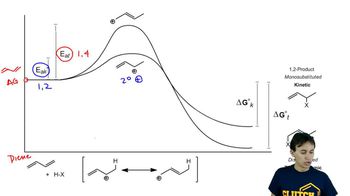
Kinetic vs. Thermodynamic Control

Kinetics

Kinetics is the branch of chemistry that deals with the rates of chemical reactions. It examines how factors such as concentration, temperature, and catalysts affect the speed of a reaction. By analyzing the activation energy and reaction mechanisms, chemists can determine which reaction will proceed faster, even if it is not the most thermodynamically favorable.
Recommended video:
Guided course
08:51
Kinetic vs. Thermodynamic Control

Reaction Mechanisms

A reaction mechanism is a step-by-step description of the pathway taken during a chemical reaction. It outlines the sequence of elementary steps, intermediates, and transition states involved. Understanding the mechanism is crucial for predicting both the rate and the favorability of reactions, as it provides insight into the molecular interactions and energy barriers that influence the overall process.
Recommended video:
Guided course
02:16
Heck Reaction Mechanism