Ch. 5 - Chemical Reaction Analysis: Thermodynamics and Kinetics
Mullins - Organic Chemistry: A Learner Centered Approach 1st Edition
Mullins1st EditionOrganic Chemistry: A Learner Centered ApproachISBN: 9780137566471Not the one you use?Change textbook
Chapter 4, Problem 46a

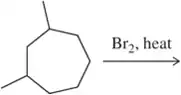
Predict the major monohalogenation product(s) of the following reactions. Indicate whether you think the reaction will be selective and justify your position.
(a) Chemical structure showing a cyclohexane derivative reacting with bromine and heat, indicating a radical halogenation process.

Verified step by step guidance
1
Step 1: Understand the concept of monohalogenation. Monohalogenation involves the substitution of one hydrogen atom in a molecule with a halogen atom (e.g., Cl, Br). This typically occurs via a radical mechanism when halogens react with alkanes under UV light or heat.
Step 2: Analyze the structure of the given molecule. Identify all types of hydrogen atoms present (e.g., primary, secondary, tertiary) and their relative positions in the molecule. This is crucial because the stability of the resulting radical intermediate determines the selectivity of the reaction.
Step 3: Recall the principle of radical stability. Tertiary radicals are more stable than secondary radicals, which are more stable than primary radicals. This stability influences the likelihood of halogenation at specific positions in the molecule.
Step 4: Predict the major product(s) based on the most stable radical intermediate. The halogen will preferentially replace a hydrogen atom at the position that forms the most stable radical. If multiple positions lead to radicals of similar stability, the reaction may be less selective, and multiple products may form.
Step 5: Justify the selectivity of the reaction. If the molecule has a clear preference for forming a specific radical (e.g., due to tertiary hydrogens), the reaction will be selective. If the molecule has hydrogens of similar reactivity, the reaction will be less selective, leading to a mixture of products.

Verified video answer for a similar problem:

This video solution was recommended by our tutors as helpful for the problem above.
Video duration:
2m
Was this helpful?

Key Concepts

Here are the essential concepts you must grasp in order to answer the question correctly.

Monohalogenation

Monohalogenation refers to the substitution reaction where one hydrogen atom in an organic compound is replaced by a halogen atom (such as Cl, Br, I, or F). This process typically occurs in alkanes and can be initiated by heat or light, leading to the formation of haloalkanes. Understanding the mechanism of this reaction is crucial for predicting the products formed.
Recommended video:
Guided course
03:09
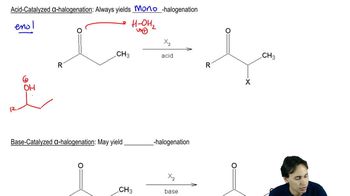
Acid Catalyzed

Selectivity in Halogenation

Selectivity in halogenation describes the preference of a halogen to replace certain hydrogen atoms over others in a molecule. Factors influencing selectivity include the type of halogen used, the structure of the alkane (e.g., primary, secondary, or tertiary), and the reaction conditions. For example, bromination is generally more selective than chlorination due to the stability of the radical intermediates formed during the reaction.
Recommended video:
Guided course
03:45
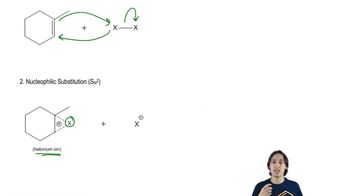
Halogenation Mechanism

Radical Mechanism

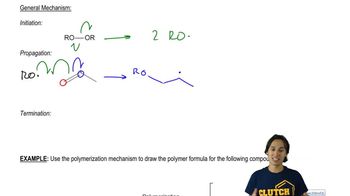
The radical mechanism is a key pathway in halogenation reactions, involving the formation of free radicals. This mechanism consists of three steps: initiation (formation of radicals), propagation (reaction of radicals with the substrate), and termination (recombination of radicals). Understanding this mechanism helps in predicting the products and the selectivity of the reaction, as different radicals can lead to different outcomes.
Recommended video:
Guided course
03:28
The mechanism of Radical Polymerization.
Related Practice
Textbook Question

The radical fluorination of 2-methyl propane resulted in a 14:86 ratio of products.

(a) On the basis of this ratio, calculate the relative reactivity of 1° and 3° C―H bonds in the radical fluorination.

1167
views

Textbook Question

Through the course of this chapter, we have discussed only alkane chlorination and bromination, yet there are two other halogens we have not discussed.

(b) Is radical iodination a favorable reaction? Do you expect it to be selective? Show your calculations.

957
views
Textbook Question

Predict the major monohalogenation product(s) of the following reactions. Indicate whether you think the reaction will be selective and justify your position.

(c)

1429
views
Textbook Question

For each of the following acid–base reactions, (i) predict which side of the reaction you expect to be favored. If a pKa is not one of the ten common ones we learned in Chapter 4, it will be given to you.

(a)

1065
views
Textbook Question

The radical fluorination of 2-methyl propane resulted in a 14:86 ratio of products.

(b) From the relative reactivity, calculate the difference in energy between the transition states of the first propagation steps leading to a 1° and 3° radical.

1068
views
Textbook Question

The following table of strain energies is associated with a variety of 1,2-gauche interactions. Use this table to answer the questions (i)–(iv).

For each of the bond rotations shown, (i) identify which you believe to be more stable, (ii) calculate ∆G°, (iii) calculate the equilibrium constant, and (iv) draw the transition state.

(c)

1108
views