Ch. 5 - Chemical Reaction Analysis: Thermodynamics and Kinetics
Mullins - Organic Chemistry: A Learner Centered Approach 1st Edition
Mullins1st EditionOrganic Chemistry: A Learner Centered ApproachISBN: 9780137566471Not the one you use?Change textbook
Chapter 4, Problem 4c

Which is the most acidic compound in each pair?
(c)

Verified step by step guidance
1
Step 1: Understand the concept of acidity in organic compounds. Acidity is determined by the ability of a compound to donate a proton (H⁺). The stability of the conjugate base formed after losing the proton plays a key role in determining acidity.
Step 2: Analyze the first compound, H₃C−CH₃ (ethane). When ethane loses a proton, the resulting conjugate base is a carbanion (CH₃−CH₂⁻). Carbanions are generally unstable due to the negative charge on a carbon atom, which is not very electronegative.
Step 3: Analyze the second compound, H−C≡C−H (ethyne or acetylene). When ethyne loses a proton, the resulting conjugate base is an acetylide ion (C≡C⁻). The negative charge is stabilized by the sp hybridized carbon, which is more electronegative than sp² or sp³ hybridized carbons.
Step 4: Compare the hybridization of the carbon atoms in each compound. In ethane, the carbon atoms are sp³ hybridized, while in ethyne, the carbon atoms are sp hybridized. Sp hybridized carbons have higher electronegativity, which stabilizes the conjugate base better.
Step 5: Conclude that ethyne (H−C≡C−H) is more acidic than ethane (H₃C−CH₃) because its conjugate base is more stable due to the sp hybridization of the carbon atom.

Verified video answer for a similar problem:

This video solution was recommended by our tutors as helpful for the problem above.
Was this helpful?

Key Concepts

Here are the essential concepts you must grasp in order to answer the question correctly.

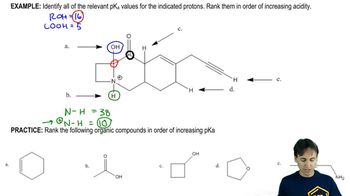
Acidity and pKa

Acidity in organic chemistry refers to the ability of a compound to donate a proton (H+). The strength of an acid is often measured by its pKa value; lower pKa values indicate stronger acids. Understanding the relationship between structure and acidity is crucial, as factors like electronegativity and resonance can significantly influence a compound's ability to release protons.
Recommended video:
Guided course
07:45
Identifying pKa values

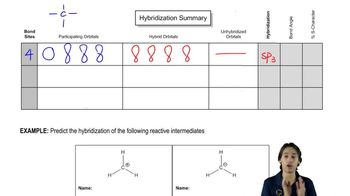
Hybridization and Acidity

The hybridization of the carbon atom in a compound affects its acidity. For example, sp-hybridized carbons (as in alkynes) are more acidic than sp2 (alkenes) and sp3 (alkanes) because the resulting conjugate base is more stable due to the higher s-character, which holds the negative charge closer to the nucleus. This concept is essential for comparing the acidity of different hydrocarbons.
Recommended video:
Guided course
10:43
Using bond sites to predict hybridization

Resonance Stabilization

Resonance stabilization occurs when a compound can distribute its electron density across multiple structures, enhancing stability. In the context of acidity, if the conjugate base of an acid can be stabilized by resonance, it will be more favorable for the acid to donate a proton. This concept helps explain why certain compounds are more acidic than others based on their structural features.
Recommended video:
Guided course
03:43
The radical stability trend.